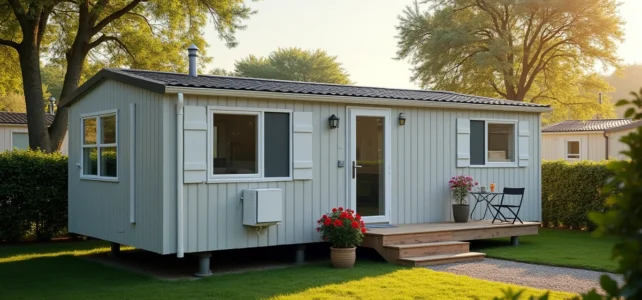
In Vendée, buying a plot with a mobile home means acquiring a movable property placed on land that you do not own, except in a specific case. This distinction between movable and immovable property affects the budget, resale rights, and taxation. Understanding the legal status of your future purchase helps avoid disappointments that the attractive entry price tends to mask.
Prior declaration and PLU in Vendée: constraints before signing
Competitors extensively detail the difference between camping and PRL, but few address the urban planning obligations that weigh on the buyer even before installation. According to Abord Immo, permanently placing a mobile home on private land requires at least a prior declaration of works. Beyond 20 m², a building permit becomes necessary.
The classification of the plot in the local urban planning plan (PLU) determines the feasibility of the project. A plot located in a natural zone (N) without exemption or in a sensitive PPRI perimeter can be sold, but Immogenius specifies that the mobile home must then be removed. Several Vendée notaries now systematically apply this rule.
In practice, a “plot with mobile home” listed at a moderate price near the Vendée coastline can turn into a bare plot after compliance checks. Checking the PLU zoning and consulting the flood risk prevention plan of the concerned municipality are the first two steps before any price negotiation. Offers for selling plots with mobile homes in Vendée therefore deserve careful examination of the local regulatory framework.

Classified camping or Vendée PRL: two land ownership regimes
The term “buying a plot with a mobile home” encompasses two legal realities that must be distinguished before comparing prices.
Location in classified camping
In camping, you sign a rental contract for the location, usually annual and renewable. You own the mobile home, not the land. The manager sets the rent, the subletting conditions, and sometimes the maximum age of the mobile home accepted in their park.
This contract can be terminated, and the manager is not obliged to compensate you for the mobile home if you have to move it. The buyer’s negotiating power remains limited against the camping’s internal regulations.
Lot in residential leisure park
In PRL, the lot can be sold with a real lease or a land transfer deed. This is the only option where the buyer can become the owner of the land. Notary fees then apply, and the capital gain on resale follows the classic real estate regime.
The price difference between the two options is significant: a lot in PRL with a land deed costs considerably more than a camping location, but it provides unmatched asset security.
Parcel rent in Vendée: an upward trend since 2024
Existing articles mention rent ranges but rarely their evolution. Community-Immo and Le Figaro Voyages report a noticeable increase in parcel rents along the coast since 2024, including in Vendée. The demand for mobile homes as accessible second homes fuels this inflation.
This increase in rents directly impacts the profitability of an investment in camping. An annual rent that rises each year mechanically reduces the rental yield if subletting rates do not keep pace.
Before signing, ask the manager for the rent history over the last three to five years and the indexing clause provided in the contract. A rent indexed to the IRL (reference rent index) remains predictable. A rent freely revised by the manager can double in a few years.
Depreciation of the mobile home and actual budget of a purchase in Vendée
A mobile home loses value each year, unlike real estate. This depreciation, often underestimated, alters the profitability calculation.
- The loss of value is rapid in the first years, then stabilizes. A second-hand mobile home a few years old costs significantly less than a new one for comparable features.
- The purchase price represents only part of the budget: transport fees, leveling, connection to networks, insurance, and annual maintenance add to the displayed amount.
- Some campgrounds require the replacement of the mobile home beyond a certain age (often around fifteen years), necessitating periodic reinvestment.
For a rental investment, the yield therefore depends less on the purchase price than on the ratio between subletting income and the total of annual charges (parcel rent, depreciation, maintenance, insurance).
Points to check before buying a plot with a mobile home in Vendée
Some concrete checks can help avoid the most costly mistakes:
- Consult the PLU of the municipality and the PPRI for plots close to the coast or a watercourse. An N zone or a high hazard makes installation precarious.
- Read the entire internal regulations of the camping or PRL, paying particular attention to clauses regarding the maximum age of the mobile home, subletting, and termination.
- Ask for the exact amount of the parcel rent, its indexing method, and additional charges (water, electricity, tourist tax, maintenance fees for common areas).
- Check if the camping is open year-round or seasonal, as this determines the allowed duration of occupation and rental potential.
Buying a plot with a mobile home in Vendée remains a leisure investment before being a financial placement. Rental profitability exists, but it requires active management and precise knowledge of recurring charges. The most common trap is not the purchase price, but the underestimation of annual costs and the depreciation of the mobile home against a parcel rent that never decreases.