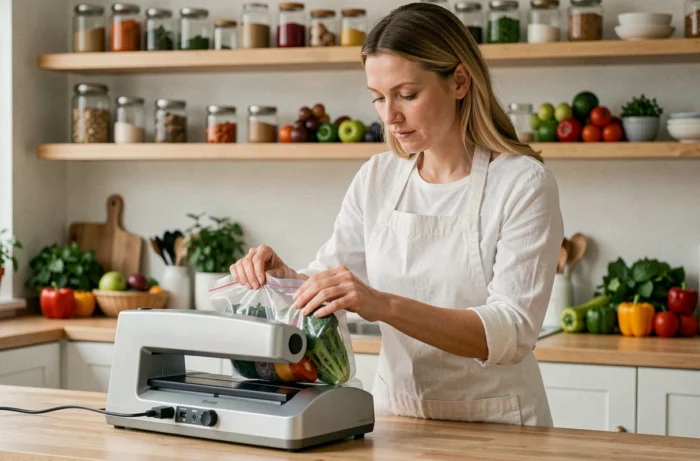
Vacuum sealing extends the shelf life of food, but it does not eliminate all microbiological risks. Measuring the actual difference between a vacuum-sealed product and a product stored in a simple freezer bag helps calibrate expectations and adapt storage practices.
Vacuum Storage Durations in the Refrigerator and Freezer: Comparison Table
Durations vary depending on the type of food and storage temperature. The table below compiles benchmarks from the recommendations of the U.S. FSIS and common practices documented by manufacturers.
| Type of Food | Refrigerator without Vacuum | Refrigerator with Vacuum | Freezer with Vacuum |
|---|---|---|---|
| Raw Ground Meat | 1 to 2 days | A few additional days | Several months |
| Raw Cuts of Meat (steaks, roasts) | 3 to 5 days | Up to twice as long | Several months |
| Blanched Fresh Vegetables | A few days | About a week | Several months |
| Chilled Cooked Dishes | 2 to 3 days | About a week | Several months |
Vacuum packaging does not replace the cold chain. The technique multiplies shelf life by a significant factor, but perishable raw foods are still subject to the same basic sanitary rules. The FSIS does not publish a specific extended timeframe for vacuum-sealed products: the original expiration date remains the safety benchmark.
For a detailed reference on vacuum food storage, indicative durations by product category help plan purchases and preparations.
Vacuum-Sealed Fish and Botulism Risk: A Often Ignored Precaution
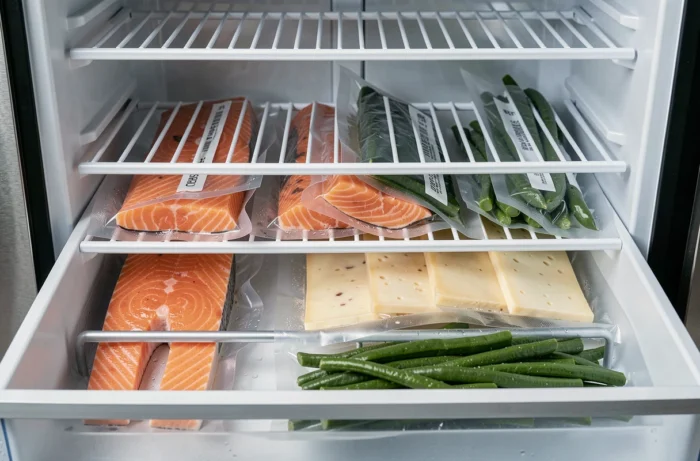
Fish is a special case that general guides rarely address in depth. The FDA recommends removing fish from its vacuum packaging before thawing it in the refrigerator. The alternative is to keep it frozen until preparation.
The reason lies in the very nature of the oxygen-free environment. Certain bacteria, including Clostridium botulinum, thrive specifically in anaerobic conditions. When fish slowly thaws in a vacuum-sealed bag, the temperature gradually rises into the range favorable for these microorganisms, without ambient oxygen to inhibit their proliferation.
High Water Content Foods and Anaerobic Environment
Fish is not the only food affected. Wet products (cooked vegetables, sauces, broth-based preparations) create an environment conducive to the development of anaerobic pathogens once vacuum sealed. The risk remains low when the cold chain is strictly followed, but it increases as soon as a temperature break occurs.
- Always cool cooked preparations before vacuum sealing, ideally below 4 °C within two hours
- Never leave a vacuum-sealed bag at room temperature during thawing
- Open the packaging if the product needs to thaw slowly in the refrigerator, to restore contact with oxygen
Sealing Quality and Bag Choice: Performance Discrepancies
The quality of the seal directly influences the shelf life. An incomplete seal allows small amounts of air to enter, gradually negating the benefits of vacuum sealing. Two technical parameters separate an effective package from a mediocre one.
Thickness and Structure of the Film
Standard embossed bags are suitable for external suction machines. Their raised structure allows air to circulate towards the suction nozzle. In contrast, smooth bags require a chamber machine, which is more expensive but capable of achieving a higher level of vacuum.
Multi-layer films incorporating a PVDC barrier offer better resistance to gas permeability. This type of film limits the gradual reintroduction of oxygen through the bag wall, a phenomenon measurable over several weeks of storage.
Liquids and Marinades: Adapting the Technique
Sealing food submerged in liquid with an external suction machine often results in the suction of juice into the sealing area. The result is a fragile seal that gives way after a few days.
- Partially freeze the liquid before vacuum sealing to limit suction
- Use a chamber machine if liquid preparations are frequent
- Leave at least five centimeters between the liquid level and the seal
- Visually check the seal after each sealing: any bubble or fold compromises the airtightness

Vacuum Freezing and Freezer Burn: What the Data Shows
Freezer burn results from the sublimation of water on the surface of frozen foods. Vacuum packaging reduces this phenomenon by eliminating the air space between the film and the food. The direct contact of the film with the surface limits dehydration.
Classic freezer bags, even of high quality, leave a residual volume of air around the food. This trapped air promotes moisture vapor exchange and accelerates the appearance of the characteristic white crystals of freezer burn.
Over several months of storage, the quality gap between vacuum-sealed food and food frozen in a standard zip bag becomes visibly apparent. The texture and color degrade significantly less with a properly sealed vacuum package.
Optimizing vacuum storage relies less on purchasing expensive equipment and more on adhering to three parameters: storage temperature, sealing quality, and the choice of film suitable for the type of food. A poorly sealed bag or a product still warm from packaging negates the benefits of vacuum sealing, regardless of the machine’s price.