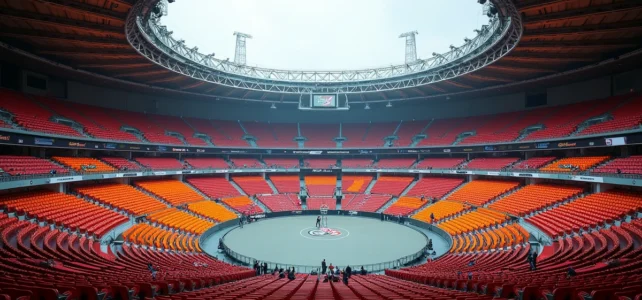
The Accor Arena, still commonly referred to as Bercy, adapts its configuration for each event. Front stage, stage with catwalk, 360-degree setup: the quality of a seat depends less on its price category than on the staging chosen for the concert or sporting event of the day.
Security checks and access doors: what changes comfort even before sitting down
The enhanced security measures around the Accor Arena involve systematic bag checks and entry routes that vary depending on the events. Some doors have much longer queues than others.
The choice of block directly influences the assigned access door. A ticket in the upper tier on the north side does not follow the same path as a floor seat. Arriving early is not enough if the assigned door is congested. To limit waiting time, identifying the door indicated on the ticket in advance and checking recent feedback from other attendees on social media can help anticipate bottlenecks.
A detailed guide on the seating plan and placement at Bercy Arena helps understand the correspondence between block, door, and actual access to the venue.

Stage configuration at Bercy: why the same category does not guarantee the same view
The Bercy venue accommodates radically different configurations. Three main types are common for concerts, and each redistributes the value of the seats.
Classic front stage
The stage is set up at one end of the venue. The central stands facing the stage offer the best overall view. The side blocks close to the stage, even classified as high category, impose a low angle on the LED screens and obscure part of the decor.
A mid-height side block often surpasses a low side block in front stage configuration. The slight elevation compensates for the angle and restores the depth of the light displays.
Advanced stage with catwalk
A catwalk extends the stage towards the center of the venue. Artists frequently move along it, benefiting spectators seated on the sides of the catwalk. Distant central stands lose some of their advantage, as the artist turns their back to them when descending onto the walkway.
For this type of setup, favoring blocks located along the catwalk, at intermediate height, provides a good balance between proximity and overall view of the show.
360-degree configuration
The stage is placed in the center of the venue. All seats offer a view, but the quality varies depending on height and distance. The front rows of low stands are the most sought after in 360, as they combine proximity with a slight downward angle. Very high seats remain usable thanks to the hanging screens, but the sound immersion decreases.

Floor or stands at the Accor Arena: deciding between proximity and comfort
The floor guarantees proximity to the stage but imposes real physical constraints. Standing for several hours in high density suits an audience willing to sacrifice comfort for energy. A few concrete criteria help make the decision:
- The floor has no seats. For a concert lasting more than two hours, physical fatigue reduces enjoyment from the second half of the show
- Visibility on the floor depends on the spectator’s height and position. Arriving among the last on the floor often means seeing the artist only on screen
- Seated stands, especially at mid-height and facing the stage, offer a clear and stable view throughout the event
- In low and centered stands, the energy of the venue remains perceptible while maintaining real visual comfort
The floor suits spectators who want to experience the concert physically. The stands are suitable for those who want to see and hear it in the best conditions.
Real view videos from your seat: the now indispensable tool
Interactive seating plans from ticket vendors display price categories, not viewing angles. A block classified in the same category as another can offer a very different experience depending on its position relative to the stage.
A recent trend complements these plans: videos filmed from specific seats circulate on TikTok and social media. By searching terms like “Accor Arena cat 2 view” or “Bercy concert stand view,” spectators post clips showing the actual angle, distance to the stage, and the atmosphere of their section.
These contents allow for a concrete verification of what a seat category offers in real situations, for a recent concert in the same venue. Consulting these videos before purchasing a ticket significantly reduces the risk of disappointment.
Sporting events at Bercy: a configuration that redistributes the best seats
The Accor Arena also hosts basketball, tennis, and events like the recent return of sumo to Paris. For these formats, the staging differs from concerts: the court or competition area occupies the center, without giant screens suspended in all cases.
- In basketball or tennis, the low side stands offer the best view of the game, unlike concerts where they suffer from the angle
- High and central seats remain acceptable for following the overall action, but the distance makes details hard to perceive
- For a sumo or combat sports event, the front rows of low stands provide an immersion that distant seats cannot compensate for
The seating logic for a sporting event is almost reversed compared to a front concert. The low side blocks, often disappointing in concerts, become the most sought after for sports.
The choice of a seat at Bercy Arena relies on three concrete parameters: the announced stage configuration for the event, the height of the block relative to the stage or court, and visual verification via spectator videos. Buying a ticket without cross-referencing these three elements amounts to betting on an experience whose quality varies significantly within the same price category.