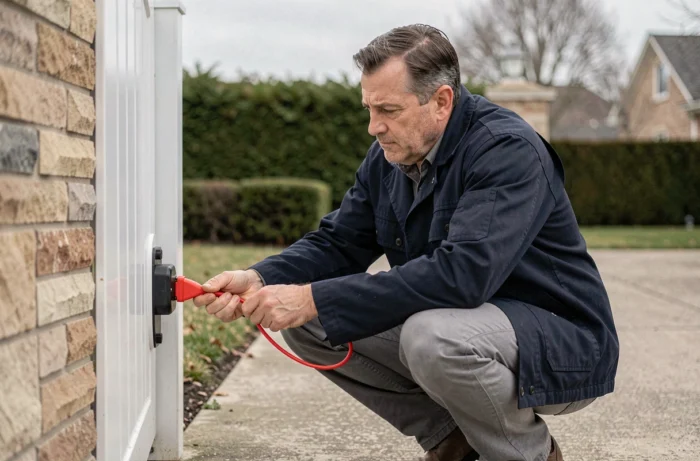
An electric gate that refuses to move after a power outage places its owner in a concrete situation: impossible to enter or exit. Almost all gate motors include a manual disengagement mechanism designed for this specific case. The procedure remains simple in theory, but it assumes knowledge of the system’s location, possession of the appropriate key, and understanding how to reset the motor once power is restored.
Compliance and technical documentation of the motorized gate
Before manipulating the disengagement, the documentary compliance of the installation deserves verification. A motorized gate falls under the EN 13241 standard and requires a CE declaration of conformity covering machinery legislation and electromagnetic compatibility.
This declaration is not a trivial administrative document. It certifies that the disengagement system, safety devices (photoelectric cells, obstacle detection), and the motor meet regulatory requirements. A gate installed without this documentation can pose a problem in the event of a disaster, particularly regarding home insurance.
Even before asking how to disengage, it is relevant to check that the technical file of the gate is complete. This file should include the manufacturer’s manual with the procedure for disengaging an electric gate, the wiring diagram, and the performance declaration. Without these documents, emergency repairs become riskier.
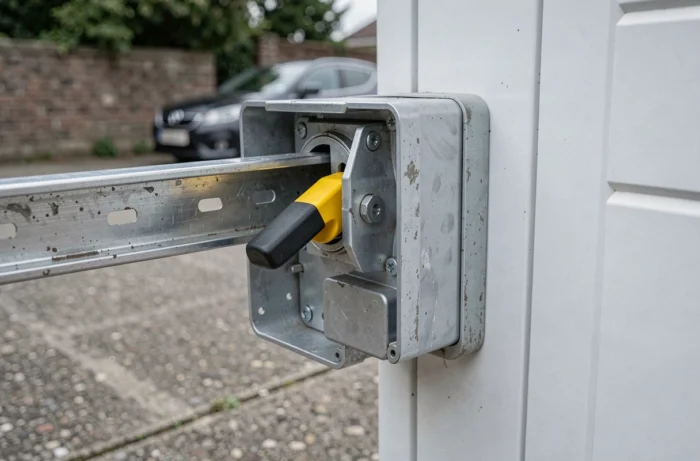
Manual disengagement of a swinging or sliding gate: two distinct mechanisms
Not all motorized gates disengage in the same way. Confusion between the two main types of motorization (swinging and sliding) generates manipulation errors that can damage the mechanism.
Swinging gate with arm or cylinder
On a swinging gate, the unlocking system is generally located on the motor itself, at the level of the articulated arm or cylinder. The standard procedure involves three steps:
- Locate the disengagement cylinder on the motor block, often protected by a plastic cover or a screwed cap
- Insert the unlocking key provided at installation and turn (a quarter turn or half turn depending on the manufacturers) to uncouple the motor from the mechanism
- Push or pull the leaf manually, which then moves freely on its hinges
Once power is restored, it is imperative to reset the motor by turning the key in the opposite direction before restarting an automatic cycle. Skipping this step can cause the motor to force against a leaf still in free mode.
Sliding gate on rail
The disengagement of a sliding gate occurs at the drive pinion. A lever or key releases the motor’s rack, allowing the panel to slide manually on its rail. The manipulation sometimes requires notable physical effort, especially on large steel or aluminum gates whose weight far exceeds that of a standard swinging leaf.
The critical point here is the cleanliness of the rail on the ground. A rail clogged with gravel, leaves, or rust makes sliding difficult, if not impossible, even in disengaged mode. This problem is rarely related to the electrical failure itself: it is a maintenance issue.
Periodic maintenance and prevention of blockages
A laborious disengagement is often a symptom of insufficient maintenance. Motorized gates covered by the EN 13241 standard require documented maintenance to ensure the proper functioning of the disengagement mechanism over time.
In practice, the maintenance of a motorized gate should include at least an annual check of the disengagement mechanism. Testing the unlocking key once or twice a year ensures that the cylinder is not seized by corrosion. Lubricating pivot points, cleaning the rail (for a sliding gate), and checking the tightness of motor fixings are part of basic maintenance tasks.
Field reports vary on the ideal frequency of this maintenance. In exposed environments (coastal areas, dusty zones), a biannual check seems more appropriate. In protected areas, an annual visit is generally sufficient. In any case, recording each intervention in a maintenance log enhances traceability in case of disputes or requests from the insurer.

Backup and solar battery: what these solutions really guarantee
Several manufacturers offer backup batteries integrated into the motorization or solar kits as an alternative to power outages. These devices deserve clarification.
A backup battery buffers the power supply to the motor for a limited time, which varies according to the battery’s capacity and the motor’s consumption. It allows for a few opening and closing cycles, but not prolonged operation. Its lifespan degrades over time, and a battery not replaced for several years may prove incapable of providing the necessary energy at a critical moment.
The solar panel connected to a gate motor operates differently from a standard home photovoltaic installation. A grid-connected solar installation automatically shuts down in the event of a general outage, unless it has an autonomous backup function with battery storage. A simple panel without a battery does not protect against a network failure.
For a solar kit to truly guarantee the autonomy of the gate, it must combine a panel, a charge controller, and a battery sized for the motor. Entry-level kits do not always meet these conditions, and the durability of these devices varies greatly depending on manufacturers and installation conditions.
Manual disengagement remains the only universal and reliable solution during a power outage. Backup systems (battery, solar) provide additional comfort but do not exempt one from knowing how to locate the unlocking key and mastering the procedure. Storing this key in an accessible location, outside the house if the gate blocks access to the entrance, avoids an absurd situation: having the solution without being able to reach it.