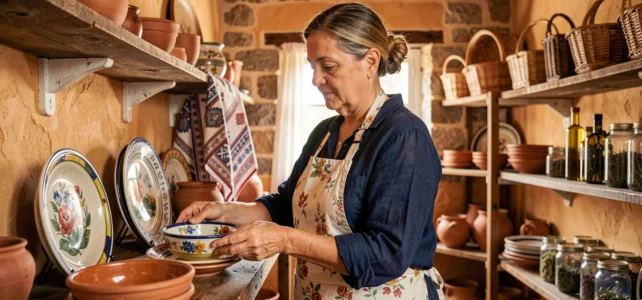
Corinth often attracts visitors for its canal and ancient ruins. But what do its traditional markets and craft workshops reveal about the current local economic life? Between recent regulations, stand specialization, and ceramic or food craftsmanship, the available data paints a more nuanced picture than that of classic tourist guides.
Greek Regulation of Popular Markets: What Changes for Corinthian Stands
A recent ministerial decision redefines the framework of λαϊκές αγορές (popular markets) in Greece, with direct consequences for the markets in the Corinth region. The text imposes strict rules on the categories of products allowed per seller.
Specifically, a professional seller can now only operate in a single category of products. It is impossible to mix textiles, food products, and craft items at the same stand. For producer sellers, each product must be precisely listed on the authorization, with supporting production documents (agricultural declarations, proof of available quantities).
| Criterion | Before the Reform | After the Ministerial Decision |
|---|---|---|
| Categories per Stand | Multiple categories possible | One category allowed |
| Producer Documentation | Simplified declaration | Detailed production proofs required |
| Stand Signage | Free | Mandatory visible standardized signs |
| Quantity Control | Poorly regulated | Consistency between declared production and volumes sold |
This reform pushes Corinthian markets towards a sharper specialization of stands, with a clear separation between agricultural producers, sellers of processed products, and artisans. For the visitor, this means clearer stalls and enhanced traceability of the displayed products.
Anyone visiting the craft shops and traditional markets in Corinth can already observe this evolution on the ground, with better-identified stands and producers clearly displaying their origins.
Ceramics and Handmade Jewelry in Corinth: Workshops Identified by Visitors
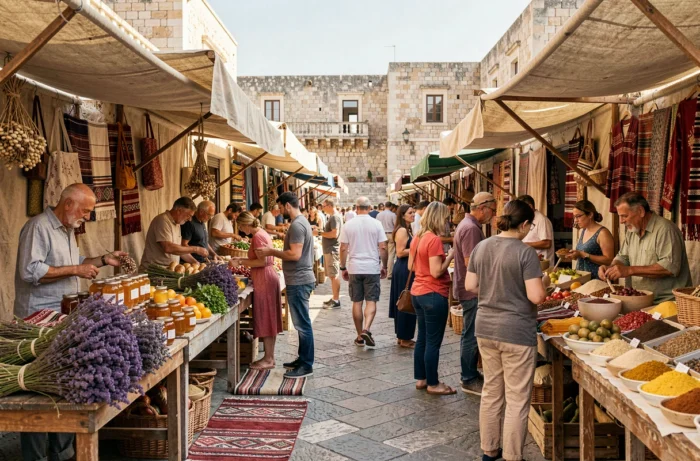
Corinthian craftsmanship is not limited to outdoor markets. Several permanent workshops attract the attention of travelers, particularly in two sectors: ceramics and jewelry.
Kilix Ceramic Crafts is among the highest-rated addresses in the city on review platforms. This artisan ceramic workshop stands out for its work inspired by ancient Corinthian forms, with production carried out on-site. Eleftheriou Jewellery and Kontzamichalis Jewellery complete the offering, each providing creations linked to local heritage.
These workshops share a common point: visible and verifiable local production by the visitor. Unlike imported souvenirs found in heavily touristed areas, the manufacturing occurs in the workshop or in the immediate vicinity.
- Kilix Ceramic Crafts: artisan ceramics inspired by ancient Corinth, produced on-site
- Eleftheriou Jewellery: handmade jewelry, workshop in the city center
- Kontzamichalis Jewellery: local jewelry creations
The artisan market at the Corinth canal serves as another landmark. Lasting about two hours, it brings together local creators and producers in a setting easily accessible for cruise passengers on shore.
Corinthian Food Products: What the Markets in the Region Really Sell
Corinthia remains an active agricultural region, and its markets reflect this reality. Corinthian raisins, olives, olive oil, and wine products from Nemea dominate the food stalls.
The Greek Gastronomy Guide lists producers, wineries, and taverns in the Nemea-Corinth area that directly supply the local markets. The Nemea wine sector (agiorgitiko grape) generates an offering of wines and derivative products found at specialized stands.
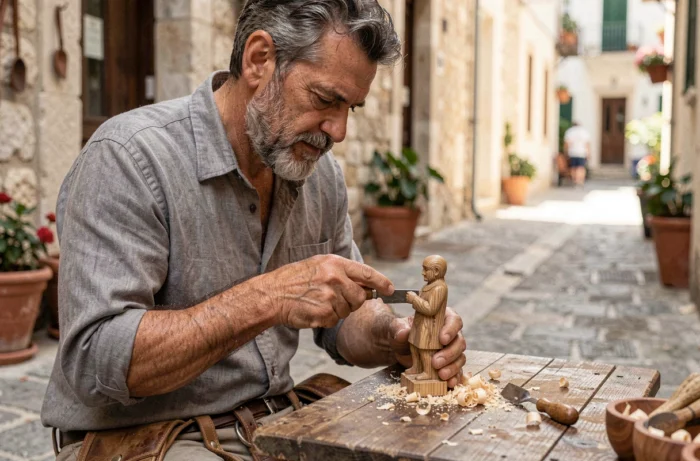
With the new regulations, sellers of processed food products (jams, pastries, preserves) must now precisely justify the origin and quantities of their production. For the buyer, this administrative constraint translates into a more reliable marking of product origins.
- Corinthian raisins: emblematic product of the region, sold in bulk or packaged
- Local olive oil: several Corinthian producers present at weekly markets
- Nemea wines: local grape varieties, frequent direct sales from producers
- Artisan bakery: establishments like Artion offer traditional breads and pastries
Corinth in a Peloponnese Itinerary: Craftsmanship and Markets as a Visit Stop
The geographical position of Corinth, at the entrance to the Peloponnese and near Athens, often makes it a transit stop. The markets and craft workshops change this logic of quick passage.
A visit combining the artisan market at the canal, one or two workshops in the city center, and a stop at a weekly market takes about half a day. This format corresponds to excursions offered from Athens, which generally combine the archaeological site of ancient Corinth and the canal.
Local craftsmanship provides a concrete complement to archaeological visits. The ceramics from Kilix Ceramic Crafts, for example, directly engage with the collections of the neighboring archaeological museum, where ancient Corinthian vases illustrate a millennia-old pottery tradition.
The growing specialization of markets, combined with the presence of identified permanent workshops, gives Corinth a more structured artisanal profile than what generic guides on the Peloponnese suggest. The recent regulation of Greek popular markets reinforces this trend by eliminating catch-all stands in favor of a more targeted and traceable offering.