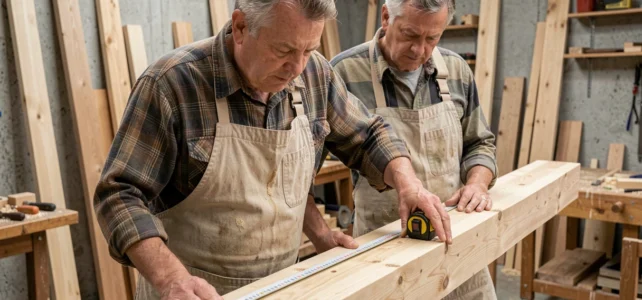
Covering 6 meters of clear span with a solid wood beam is the threshold where standard sections are no longer sufficient. Beyond this distance, the choice of species, strength class, and type of load directly condition the height and width of the beam. Miscalculating the section risks visible deflection after a few months, or even structural sagging.
Creep and delayed deflection: the real trap of a 6-meter span
On a short span (3 or 4 meters), a slight underestimation of the section often goes unnoticed. At 6 meters, the wood operates in a zone where creep becomes the limiting factor, well before failure.
Creep is the slow deformation of wood under permanent load. A joist that seems correct at installation may show several millimeters of additional deflection over the years. Therefore, the section is sized not just to “hold” on the day of installation, but to remain within acceptable deflection limits throughout the lifespan of the structure.
To choose a suitable wood section for a 6-meter span, this creep coefficient must be integrated from the initial calculation. Ignoring this parameter leads to beams that meet ultimate strength but exceed the allowable deflection in service.
In practical terms, the Eurocode 5 standard requires checking two limit states: the ultimate limit state (the beam does not break) and the service limit state (the beam does not deflect beyond a visible threshold). Over 6 meters, it is almost always the latter that dictates the section.
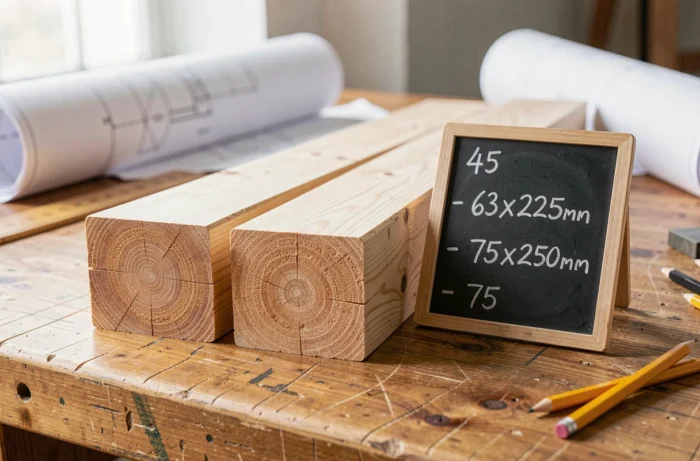
Solid C24 wood or glued laminated timber: what section for a 6-meter span
Solid wood classified C24 remains the standard in common construction. Since the revision of standard EN 338:2016, its characteristic tensile strength has increased to 14.5 N/mm². This gain seems modest, but it changes the section checks for long beams.
Be careful: many online tables still rely on the old values (2009 standard). Using these tables without verification can lead to oversized or poorly verified sections.
Solid softwood in C24
For a single C24 softwood beam covering 6 meters, one quickly ends up with very large section heights. The simplified rule of “5 cm of height per meter of span” (used for flat roof beams of garden sheds) would yield 30 cm in height, which only applies for light loads and tight spacing.
As soon as one loads a residential floor or a roof with heavy insulation, one must move to much larger sections, sometimes close to 100 x 400 mm or even beyond. This is where solid wood reaches its practical limits: sawmills do not commonly produce sections beyond 300 mm in height for softwoods.
Glued laminated timber GL24h and beyond
Glued laminated timber overcomes this constraint. The assembled laminates allow for section heights of 400, 500 mm or more, with mechanical homogeneity superior to solid wood. For a 6-meter span under normal service loads, a GL24h beam offers a better section/performance ratio than solid softwood.
Glued laminated timber in Douglas fir or spruce remains the dominant choice for this type of span. It also allows for narrower widths at equal heights, simplifying integration into walls or floors.
Service loads and Eurocode categories: what changes the game
The section is not chosen in absolute terms. It directly depends on what the beam supports, and the classification of loads is evolving.
The second-generation Eurocodes introduce finer categories of service loads for roofs and terraces:
- Category H for inaccessible roofs, where the combination coefficient changes from 0.0 to 0.5, significantly increasing the quasi-permanent load to be considered.
- Category I for accessible roofs, with higher load levels than in category H.
- Category T for terraces and balconies, which imposes specific service loads related to occupancy.
For a 6-meter beam supporting a roof or terrace, these new categories lead to a higher quasi-permanent load level than what is recommended by general guides based on the old categories. Feedback varies on this point among engineering offices, but the trend is clear: sections calculated today are often larger than those found in tables from ten years ago.
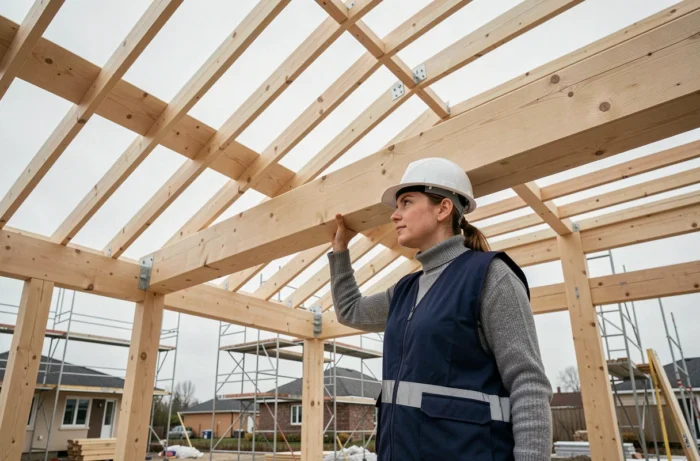
Field verification: the parameters we forget in the tables
A table provides a section for standard conditions. In the field, several factors can modify the result.
- The service class (1, 2, or 3) reflects the ambient humidity. A beam in class 2 (unheated building, open shelter) has its mechanical properties reduced compared to class 1 (heated interior). Over 6 meters, this reduction is enough to move from one section to the next.
- The spacing between beams changes everything. Doubling the spacing doubles the load taken by each beam. On a floor with joists spaced 60 cm apart, the supporting beam takes much less load than if the spacing increases to 100 cm.
- The support conditions influence the effective span. A simple support (beam resting on a wall) does not have the same effect as a partial embedment. On a masonry wall, a minimum support on both sides is generally counted to ensure the calculation span remains at 6 meters and not more.
The treatment of the wood also comes into play. An untreated softwood in risk class 2 requires a fungicidal treatment to ensure mechanical durability over time. Without appropriate treatment, creep accelerates in humid environments and the theoretical section is no longer sufficient.
Dimensioning with software or consulting an engineering office
For a 6-meter span, we leave the realm of manual estimates. Wood dimensioning software (compliant with Eurocode 5) allows for simultaneous integration of the strength class, service class, permanent loads, service loads, and creep coefficients.
These tools remain accessible to motivated self-builders, but their configuration requires an understanding of the calculation assumptions. An error in the load category or service class skews the entire result.
For a 6-meter span intended for a habitable floor or a terrace roof, validation by a structural engineering office remains the only normative guarantee. The cost of a calculation note represents a fraction of the framing budget, and it secures both the choice of section and compliance with insurance.