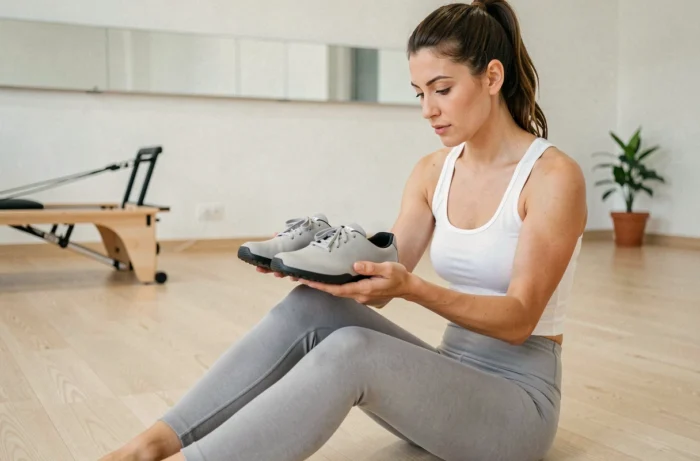
Pilates is most often practiced barefoot or in socks. However, the question of shoes arises as soon as one moves from a traditional mat class to the Reformer, or alternates with other activities in the gym. The choice of footwear primarily depends on the type of session, the studio’s regulations, and the surface on which the foot is working.
Ground grip and proprioception: what the foot really does in Pilates
During a Pilates exercise, the body’s weight constantly shifts between the forefoot, the arch, and the heel. This fine mobility activates what is called proprioception, the foot’s ability to inform the brain about the body’s position in space.
A typical sports shoe, with its thick sole and pronounced cushioning, cuts off part of this sensory feedback. The foot receives less information from the ground, complicating the precise placement required by the method.
On a Reformer, the problem worsens: sneakers can hinder the placement of the foot on the bar, straps, and carriage. In fact, most studios prohibit shoes on this equipment.
Before investing, it is essential to clearly identify whether the practice takes place on the floor, on a machine, or in a mixed context (gym, group fitness class). You can check the best Pilates shoes on 1 Sport 1 Coach to compare options suitable for each configuration.
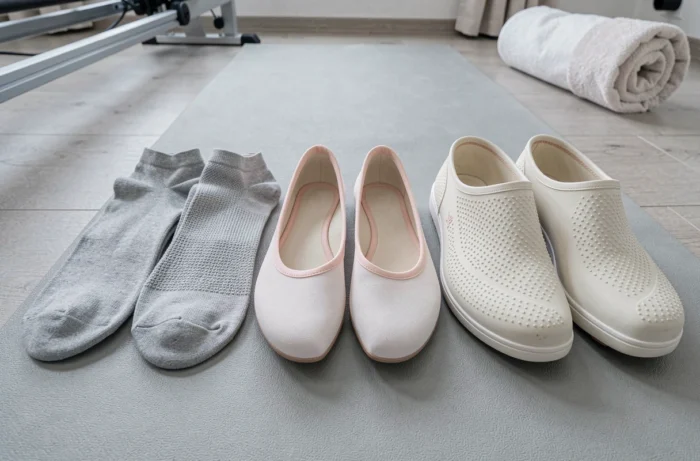
Non-slip socks: the alternative that studios impose
In the majority of Reformer classes, non-slip socks replace shoes. This is not just a comfort accessory: some studios require participants to wear these socks for hygiene and safety reasons on vinyl surfaces.
Not all grip socks are created equal. The determining factor is the coverage of the non-slip sole.
- Models with limited grip at the heel and forefoot are suitable for static exercises but leave the arch without traction during weight transfers.
- Models with extended grip across the entire sole are more versatile for dynamic movements where the foot pivots or intentionally slides on the carriage.
- A rarely mentioned point: the sock can slip inside even if its sole adheres well to the Reformer. The support of the heel, the fit of the arch, and the absence of wrinkles inside the sock are as important as the external grips.
Some recent models add interior grip to limit foot movement within the sock. This double grip (inside and outside) is worth looking for if the sessions are intensive.
Wear and maintenance of Pilates socks
Grip decreases with repeated washings. The silicone grips gradually lose their texture. Regular visual checks allow you to ensure that the pads are not flattened or detached.
The usual recommendations suggest machine washing at low temperatures, inside out, without fabric softener. Fabric softener leaves a film that reduces the grip of the silicone. When grip noticeably decreases, replacing the pair is preferable to compensating with forced posture.
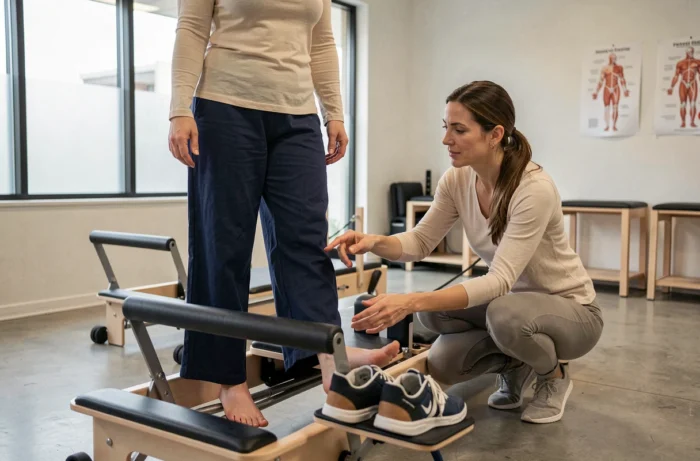
Minimalist shoes for Pilates in the gym or mixed training
The situation where a real shoe becomes relevant is mixed training. If the Pilates session is followed by fitness, strength training in the gym, or training on a hard floor, taking off and putting on shoes between each activity is not practical.
In this context, flat and thin training shoes offer an acceptable compromise. Here are a few technical criteria to check:
- Flexible sole with a low drop (difference in height between heel and forefoot) to maintain contact with the ground.
- No rigid lateral reinforcements that block foot mobility during flexion and articulation movements.
- Mesh upper or lightweight material to limit the feeling of confinement and maintain some ventilation.
Running shoes, with their thick cushioning and high drop, remain unsuitable. They elevate the heel and alter the natural alignment of the pelvis during floor exercises. Gym or indoor training models, especially those designed for cross-training, are closer to what Pilates requires in terms of stability and ground contact.
Studio regulations and type of session: check before buying
The choice between barefoot, socks, and shoes is not solely a matter of preference. The studio’s regulations often dictate what is allowed. Small group mat classes generally accept bare feet. Reformer studios frequently require non-slip socks. Multi-purpose gyms may require clean sports shoes for collective hygiene reasons.
Before investing in a specific model, contacting the studio or checking its access conditions can prevent unnecessary purchases. A practitioner who alternates between two locations (specialized studio and gym) often needs both: a pair of non-slip socks for the Reformer and a minimalist shoe for gym sessions.
Bare feet remain the reference in Pilates for the quality of sensation and freedom of movement. Any footwear solution aims to get as close to this as possible, not to move away from it. A purchase suited to one’s practice context, verified before the first session, protects both the stability of postural work and the material budget.