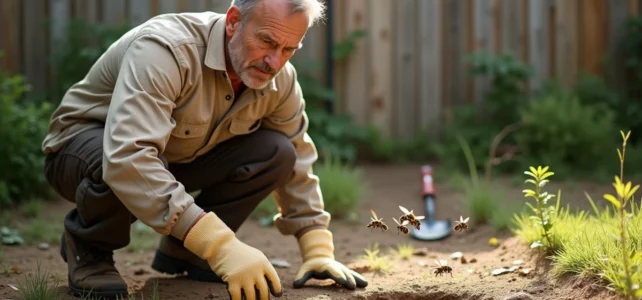
A hole in the lawn, a back-and-forth of yellow and black striped insects close to the ground: the ground wasp nest often reveals itself by accident, while mowing or walking barefoot. The immediate reaction determines the next steps. Identifying the species, assessing the distance between the nest and living areas, and then deciding if destruction is truly necessary are the three steps that separate controlled management from a hasty intervention.
Identify the species before any decision: ground wasp, bumblebee, or solitary bee
Not all insects that nest in the ground pose the same level of risk. Social ground wasps (mainly of the genus Vespula) build colonies that can reach several hundred individuals by late summer. Bumblebees, which are stockier and fuzzier, also occupy underground cavities but are very rarely aggressive. Solitary bees, on the other hand, dig individual galleries and almost never sting.
Confusing these species leads to unnecessary, sometimes costly interventions. Observing their behavior from a distance for a few minutes is often sufficient: a steady flow of insects entering and exiting the same hole indicates a social colony. Scattered comings and goings around several small holes suggest solitary bees, which pose no safety issues.
Knowing what to do when faced with a ground wasp nest starts with this identification step, without which any reaction risks being disproportionate. A person alerting a professional or their local authority will save time by providing a precise description of the insect and the observed behavior.
Ground wasp nest and cohabitation: conditions that make maintenance realistic
The systematic destruction of a ground wasp nest is not the only option. A nest located far from high-traffic areas can be safely retained, provided a few concrete parameters are respected.
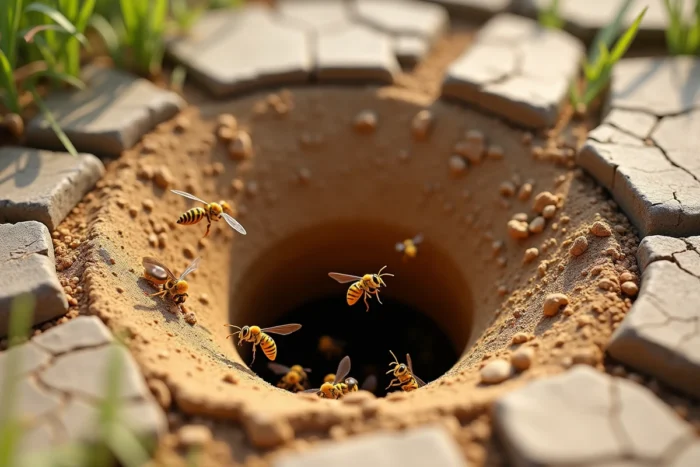
Distance between the nest and living spaces
A nest located at the back of the garden, in a slope or under a rarely visited flowerbed, does not pose the same threat as a nest near a terrace or playground. The actual traffic in the area matters more than the raw distance in meters.
If no one regularly passes near the hole, the risk of stinging remains low. Ground wasps defend their nest when they perceive vibrations (mower, heavy footsteps) or an obstacle in front of the entrance. Outside this defense perimeter, they go about their activities without particular aggression.
Measures to secure the area
Rather than destroying, marking may sometimes suffice:
- Place a visible marker (stake, ribbon) to signal the nest’s location to other garden occupants and visitors.
- Cease mowing within a sufficient radius around the hole during the active season, as engine vibrations are the main trigger for attacks.
- Avoid leaving sweet food or organic waste nearby, which would limit the comings and goings of worker wasps to living areas.
- Inform children and allergic individuals of the exact location of the nest.
Social wasp colonies are annual. Each autumn, with the first frosts, the colony dies. Only the young fertilized queens hibernate, and they will establish a new nest elsewhere the following spring. A nest discovered in August will therefore be naturally abandoned a few weeks later.
Why keeping a nest benefits the garden
Wasps are predators of caterpillars, flies, and aphids. An active colony naturally regulates pest populations over several dozen meters around the nest. Systematically destroying these colonies means depriving oneself of a free biological control agent.
This approach to cohabitation, based on perimeter protection and maintaining a safety distance, is now considered an acceptable and more respectful response to biodiversity.
When the destruction of an underground nest becomes necessary
Cohabitation has its limits. Certain situations require a swift intervention.
A nest located under a terrace, in a play area, or near a house entrance poses a daily risk. The presence of an allergic individual to hymenopteran venom in the household also changes the equation: a single sting can trigger anaphylactic shock.
The number of observed insects gives an indication of the colony’s maturity. Early in the season (May-June), the nest is still small, and the queen may be alone with a few workers. Intervening at this early stage significantly reduces the risk. In contrast, a nest discovered in mid-summer houses a well-developed and much more reactive colony.
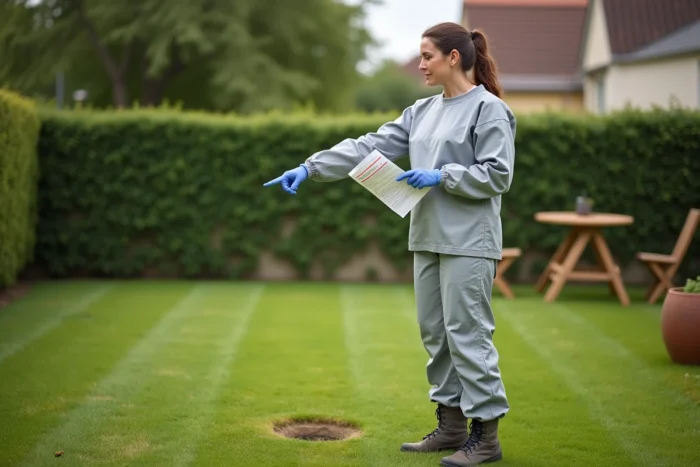
Professional intervention or self-management
For a mature underground nest, the intervention of a professional (pest controller, firefighter in certain municipalities) remains the safest solution. Field reports vary on the effectiveness of home methods: insecticidal powder poured into the hole, boiling water, blocking the entrance at night. These techniques sometimes work on small colonies, but they expose one to multiple stings if the colony is large.
A professional generally intervenes at dusk or early morning when almost all workers have returned to the nest. They use an insecticide in powder or aerosol form injected directly into the gallery. The cost varies depending on the service providers and regions.
Prevention: spotting a ground wasp nest before it grows
Regular inspection of the garden starting in June allows for the early detection of nests. Founding wasps seek existing cavities: old rodent burrows, gaps under slabs, holes in slopes.
- Monitor areas of loose soil, flowerbed edges, and hedge bases where holes appear.
- Seal unused cavities (old burrows, cracks in walls) before the season starts.
- Observe insect behavior: a single individual making regular trips to a hole in May-June indicates a queen establishing her colony.
This weekly inspection protocol reduces the risk of discovering a mature nest in mid-season when intervention becomes more complex and dangerous.
Managing a ground wasp nest in a garden relies on a balance between immediate safety and ecological interest. A nest far from frequented areas, marked and monitored, will naturally disappear by autumn. A poorly placed nest or one discovered late justifies a targeted intervention, preferably entrusted to a specialist.