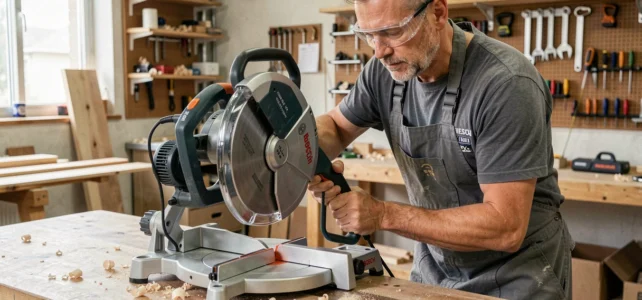
The Bosch GCM 12 GDL is a sliding miter saw that consistently comes up in workshop discussions, both among professional carpenters and demanding hobbyists. To assess this machine beyond marketing claims, one must look at its cutting capabilities, actual precision, and the compromises it imposes in daily use.
Technical specifications of the Bosch GCM 12 GDL compared to the competition
The specifications announced by Bosch place the GCM 12 GDL in the high-end segment of sliding saws. The table below puts the available data into perspective.
| Criterion | Bosch GCM 12 GDL | Mid-range segment (e.g., Metabo KGS 216M) |
|---|---|---|
| Blade diameter | 305 mm | 216 mm |
| Guiding system | Frictionless axial slides | Standard guide bars |
| Miter | Adjustable on both sides with angle presets | Adjustable with fixed stops |
| Bevel | Left and right tilt | Single tilt (one side) |
| Cutting laser | Integrated | Absent or optional |
| Footprint | Large | Moderate |
The transition from a 216 mm blade to a 305 mm blade radically changes the cutting capacity. On wide pieces (tall baseboards, crown moldings, panels), the difference is felt from the very first use.
Our test of the Bosch GCM 12 GDL details the actual cutting measurements obtained on various types of wood, allowing verification of whether the claimed capabilities match practical use.
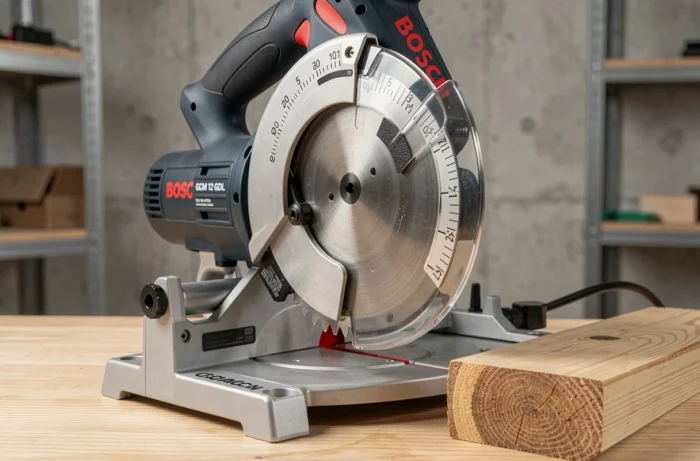
Axial slide system: what it changes for precision
Most sliding saws use round bars on which the head slides. This reliable mechanism generates lateral play over time, degrading precision. The GCM 12 GDL adopts a frictionless axial slide system borrowed from industrial machines.
In practice, the cutting head descends and advances without parasitic resistance. The saw line remains consistent from one end of the piece to the other, even on bevel cuts combining miter and bevel.
This system also has a rear footprint advantage. Standard bars extend behind the machine when the head is pulled towards the user. The axial slides remain contained within the body of the saw, allowing you to place the machine against a wall without losing cutting stroke.
Laser adjustment and line marking
The integrated laser projects a line onto the piece to be cut. On specialized forums, several users report that this laser requires recalibration after the first transports. Once properly adjusted, it provides a reliable visual reference for repetitive cuts.
Working in natural light sometimes makes the laser line difficult to distinguish. In a workshop lit by neon lights, visibility remains acceptable. This point deserves attention if you regularly work outdoors.
Miter and bevel cuts: actual capabilities and limits
The double left-right bevel tilt eliminates the need to flip the piece to achieve compound angles. For crown molding or framing work, this feature saves considerable time and reduces positioning errors.
- The angle presets for miter cuts (the most common for frames and baseboards) allow for quick locking without checking with a protractor
- The miter can be adjusted beyond standard positions, covering unconventional angles encountered in older renovations
- The combined bevel with the miter allows for complex compound cuts in a single pass, where a single-tilt saw requires two manipulations
However, the maximum cutting width decreases as soon as the blade is tilted for bevel cuts. This is a common physical constraint for all sliding saws, but it is felt more acutely on pieces close to the maximum capacity.
Dust extraction and daily management
Bosch provides a dust bag with the GCM 12 GDL. This bag captures some of the sawdust, but the extraction remains insufficient without connection to a workshop vacuum. Cuts in oak or beech produce a volume of shavings that the bag alone cannot handle.
The extraction port is compatible with standard industrial vacuums. In real conditions, a vacuum connected to the rear nozzle significantly improves workplace cleanliness and visibility of the cutting line.
Weight and transport of the machine
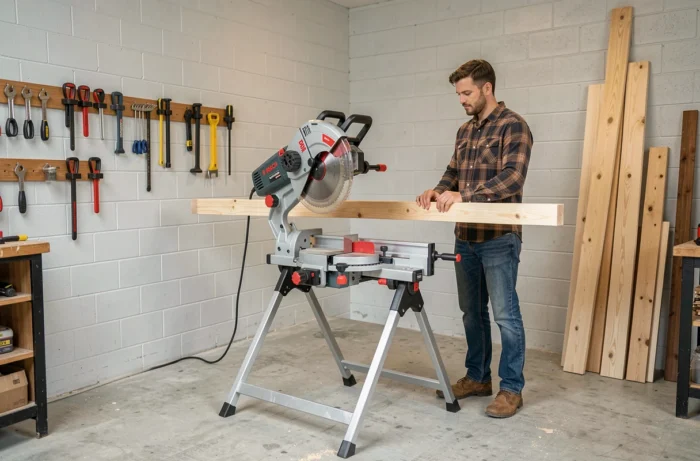
The GCM 12 GDL is a heavy machine. This weight contributes to its stability during cutting but complicates transportation on site. Two people are needed to move it comfortably, and a rolling support should be planned if you frequently change workstations.
For fixed use in a workshop, this weight is not an issue. For tradespeople who move daily, this logistical constraint must be factored into the choice of the machine.
European regulation and future documentation
The Regulation (EU) 2023/1230 on machinery replaces Directive 2006/42/EC as of January 20, 2027. From this date, manufacturers will be required to provide user instructions and the declaration of conformity in a durable digital format. The buyer will retain the right to request a paper version within one month of purchase.
For current owners of the GCM 12 GDL, this means that future updates to technical documentation will follow this new framework. No recalls or material modifications are involved, but the documentary traceability of machines of this type will evolve.
The Bosch GCM 12 GDL remains a sliding saw whose cutting performance and axial slide system justify its price positioning. Its weight and the need for an external vacuum are the two compromises to accept. For a fixed workshop focused on precision woodworking, the technical data speaks for itself.