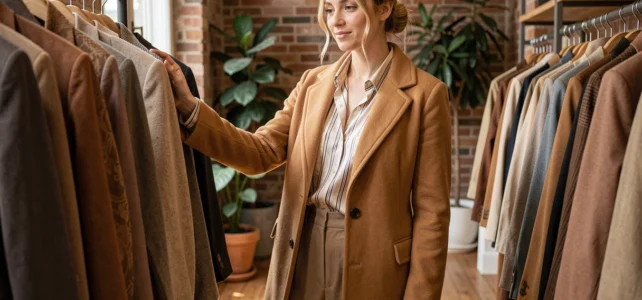
A raw denim worn three days in a row with white sneakers, a linen jacket found at a flea market, a scarf tied in a hurry: everyday style is rarely built in front of a full-length mirror. It is created within the constraints of the week, between the bike ride and the 9 o’clock meeting.
Adopting a unique style is less about fashion trends and more about a method for sorting, assembling, and repeating what works for oneself.
Capsule wardrobe: reducing the number of pieces for greater coherence
We often start from the wrong end. We accumulate clothes “just in case,” pile up impulsive purchases, and then find ourselves every morning in front of a full wardrobe with nothing to wear. The first concrete step to building a personal style is a simple operation: remove everything you haven’t worn in the last six months.
This brutal sorting reveals a core of pieces that we instinctively reach for. Generally, about fifteen garments cover most situations. This is the principle of the capsule wardrobe: a streamlined wardrobe where each piece can be combined with at least three others.
Recent surveys on personal style confirm this shift. Quality, cut, and comfort are now considered more decisive than brand or current trends. We talk about “comfort-first style”: choosing what lasts over what looks good on a screen. Those interested in fashion on Les Humeurs de Gloupsy Chérie will find this logic applied to concrete outfits, far from the runways.
The capsule wardrobe does not impose a minimalist style. It imposes a constraint that, paradoxically, frees creativity. When you have ten tops instead of forty, you dare to make combinations you would never have tried.

Colors and patterns: building a personal clothing palette
Wearing black by default is a solution. Not a style. To break free from the uniform without falling into disguise, one can work on their palette like a decorator works on a room: starting with two or three base colors and then adding an accent shade.
Finding your base colors
Look at what you already enjoy wearing. If navy blue, off-white, and khaki frequently appear, that’s a signal. Your personal palette is discovered in habits, not in a color chart. Start from there and eliminate what clashes.
Integrating patterns without overwhelming
Patterns (stripes, checks, floral prints) work when they remain isolated in an outfit. One pattern per look, combined with solid pieces, is enough to create uniqueness. Layering patterns is a form of intentional maximalism, an aesthetic choice that requires practice.
Maximalism is gaining ground in interior design as well as in fashion. According to the latest annual survey by the platform 1stDibs among 468 design professionals, maximalism is the most requested style. In clothing, this trend translates into mixing textures, saturated colors, and bold accessories. Reactions vary on this point: some find it natural, while others prefer to gradually incorporate it.
Accessories and details: markers of a recognizable style
We identify someone by their details, not by their basics. A watch worn on a fabric strap, mismatched earrings, a weathered leather bag: these are the elements that anchor a style over time.
- The watch or bracelet: worn every day, they become a visual signature. Choosing a model that you never take off creates a recognizable constant.
- The bag or satchel: its shape, material, and color say more about a style than any top. A waxed canvas bag tells a different story than a pebbled leather tote.
- Shoes: they set the tone of an outfit. Leather derbies elevate a pair of jeans, while sneakers bring it back to casual. Changing shoes transforms a look without touching anything else.
- Glasses: round, rectangular, colorful, or discreet frames change the perception of the face and overall style.

A common mistake is to overload on accessories in a single look. This creates a “display” effect that drowns out personality instead of revealing it. Two or three carefully chosen accessories are better than a pile-up.
Enclothed cognition: when clothing alters attitude
The concept of enclothed cognition, studied in social psychology, describes the influence of clothing on the cognitive processes of the wearer. In short, what you wear affects how you think and behave.
This is not about brand or price. Wearing a structured jacket during a negotiation does not change skills, but it alters posture, gestures, and perceived confidence. Conversely, putting on clothing that is too tight or that you don’t identify with generates discomfort that is reflected in your attitude.
Recent data shows that the majority of respondents consider self-care (grooming, fitted clothing, cleanliness of garments) as a central factor in their daily style. A unique style, therefore, is not limited to the choice of pieces. It includes how they are maintained, how they are adjusted, and how they are physically inhabited.
Adapting your style to your real lifestyle
A style designed for an air-conditioned office does not survive a day outdoors. Starting from your daily constraints prevents the accumulation of unusable clothing. List your typical activities over a week, then check that each piece in your wardrobe covers at least two of these contexts.
This pragmatic approach aligns with the comfort-first trend observed in recent years. A unique daily style is not decreed in a magazine. It is built through elimination, experimentation, and especially through repetition of what truly works in your own life.