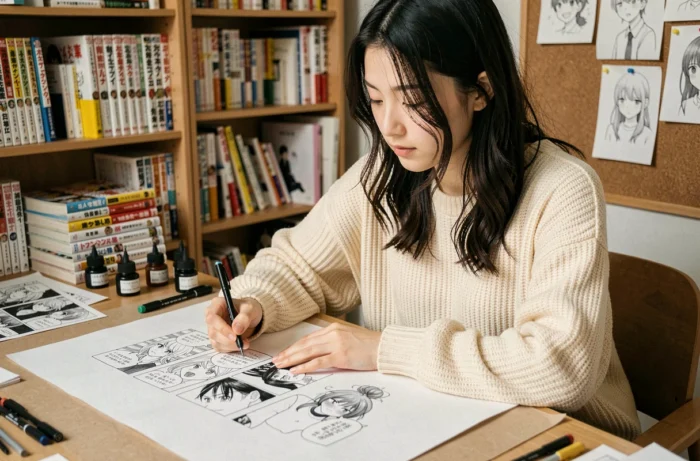
A budding mangaka opening Clip Studio Paint for the first time faces a concrete question: where to start when AI tools are already generating entire pages, and the legal framework surrounding AI-created works is tightening in Japan? The answer lies in a skill set that machines have not yet replaced, and in a proven production method that can be adapted to one’s pace.
Creative Skills of the Mangaka in the Face of Generative AI
Let’s start with a recent case. In 2026, Arab News Japan reported the existence of a manga entirely drawn by artificial intelligence, raising concerns about employment and copyright in the Japanese industry. The debate over the legal status of these works has intensified in Japan, meaning that a mangaka relying solely on AI to produce their pages is navigating in a gray area.
What AI can do today: generate backgrounds, propose variations of poses, colorize monochrome pages. What it cannot do: build a coherent narrative over multiple volumes, manage a character’s emotional progression, balance the pace between action and silence. The script and narrative breakdown remain the territory of the human creator.
Therefore, one can use AI as an assistant to speed up certain repetitive tasks (textures, urban backgrounds, provisional lettering), but artistic direction, storyboarding, and scriptwriting require a skill set that cannot be automated. To discover I Announce online, there is a useful overview of the skills expected before getting started.
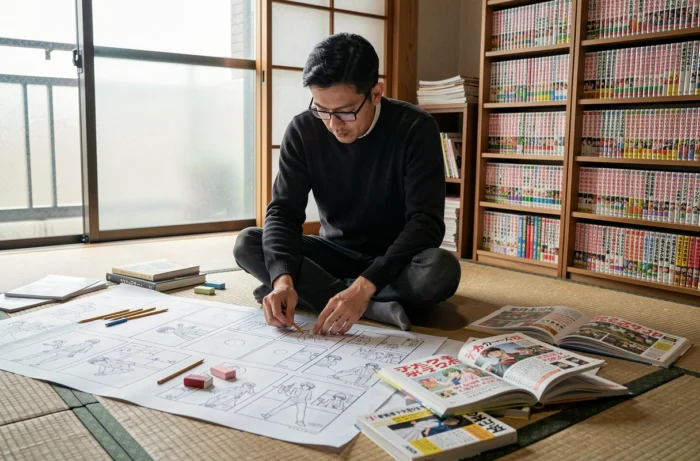
Script and Manga Storyboard: A Work Method That Lasts
Many beginners jump straight into drawing. In practice, professional mangakas spend the majority of their time on two stages that are invisible to the reader: the script and the storyboard (called nemu in Japan).
Establishing the Narrative Skeleton Before Drawing
We start by defining three elements: the main character and their motivation, the central obstacle, and the expected transformation at the end of the arc. No need for a fifty-page document. A one-page summary per chapter is enough to structure the story.
A common pitfall is to multiply secondary characters right from the first chapter. Feedback varies on this point, but most publishers advise limiting the initial cast to three or four characters so that the reader can quickly become attached.
Storyboard: Testing the Rhythm Before Inking
The storyboard is sketched quickly and poorly, intentionally. Rough sketches, dialogue indications, movement arrows. The goal: to ensure that each page advances the story. If a double page contains neither new information nor emotion, it gets cut.
- Break each chapter into sequences of four to six pages, each with a mini-narrative goal (revelation, confrontation, transition).
- Vary the size of the panels: a full-page panel for a strong moment, narrow panels to speed up the pace of a chase or tense dialogue.
- Read the storyboard aloud while timing: if you get bored reading, the reader will too.
Inking and Manga Pages: Producing Without Exhaustion
Inking is the stage where the drawing takes its final form. Traditionally, one works with a pen (G-pen, maru-pen) on manga paper with blue markers. Digitally, Clip Studio Paint dominates the market among independent mangakas as well as studios.
Producing pages regularly matters more than graphic perfection. A mangaka published in a weekly magazine delivers about twenty pages per week, often with assistants. Solo, aiming for four to eight pages per week is already a demanding pace.
To maintain this rhythm, one prepares libraries of reusable elements: recurring backgrounds, texture patterns, standardized facial expressions. This is where AI can serve as an accelerator, for example, by generating a reference urban background that is then refined by hand.
Becoming a Freelance Mangaka: Contracts, Copyright, and Legal Protection
The model of the solitary mangaka sending their pages to a publisher without a formal contract is fading. In Japan, the freelance law that came into effect in November 2024 now requires written contracts, prohibits unpaid work, and sets a payment deadline. For a creator based in France, the situation is different but the logic remains the same: any agreement with a publisher or studio must be formalized in writing.
On the copyright side, the issue becomes more complicated with AI. If one uses an image generator to produce elements for their pages, the ownership of rights to these elements is not clearly defined in most jurisdictions. In Japan, the debate intensified in 2026, and rights holders are now using AI tools themselves to detect the piracy of their works.
- Keep source files (layers, storyboards, drafts) to prove the originality of your work in case of a dispute.
- Check the terms of use of any generative AI tool before integrating it into a publication workflow.
- Formalize the distribution of rights through a contract if working with a scriptwriter, assistant, or colorist.
The best protection remains an identifiable graphic style and a personal narrative universe. A distinctive style and an author’s voice cannot be copied by an algorithm. The journey to becoming a mangaka always involves hundreds of pages drawn, reviewed, and corrected, but awareness of the legal framework surrounding AI and contracts is now part of the profession, just like mastering the pen.