
When changing smartphones in 2026, users will no longer just look at the technical specifications. The battery must last two days, the screen must remain readable in bright sunlight, and the issue of repairability arises even before the purchase. The rules of the game are changing, driven by European regulatory constraints that require manufacturers to rethink their designs.
User-replaceable battery: what European regulations require for smartphones
We start with the most concrete change for users. Regulation (EU) 2023/1542 on batteries mandates that, starting February 18, 2027, smartphone batteries must be easily removable and replaceable by the user with common tools. Gone are the days of needing proprietary tools, heat, or solvents to extract a glued battery.
Manufacturers must also ensure the availability of compatible batteries for at least five years after the sale of the last unit of a model. For brands that have spent a decade gluing, sealing, and making their devices irreparable, this shift is drastic.
At the same time, the ecodesign regulation for smartphones and tablets, in effect since June 2025, imposes a specific technical requirement: the battery must retain at least 80% of its capacity after 800 charge cycles. There is also the obligation to provide spare parts (screen, battery, camera, charging port) for at least seven years after the end of marketing.
To keep up with the news on these developments and compare the relevant models, one can consult https://www.mobiles-infos.com/ which lists the technical specifications of the main smartphones on the market.
An energy label with a repairability score (from A to G) now accompanies each device sold in Europe. This score is already influencing purchasing decisions in stores that display it on the shelves.

Smartphone design in 2026: how waterproofing adapts to removable batteries
The technical challenge is clear: how to offer a waterproof smartphone (IP68 or higher) while making the battery accessible without specialized tools? Feedback on this point varies among manufacturers, and solutions differ.
Some manufacturers are exploring mechanical fastening systems to replace structural adhesive, while others are focusing on modular designs that facilitate battery access. The common goal remains to maintain waterproof certification while adhering to European standards.
What this changes in daily life
For us, the users, this means we will be able to replace a tired battery without an appointment at a workshop. A home battery replacement in just a few minutes becomes a realistic scenario by 2027. The useful life of a device is mechanically extended, which reduces the pressure to renew every two years.
Screen and photography: the real criteria for choosing between high-end smartphones
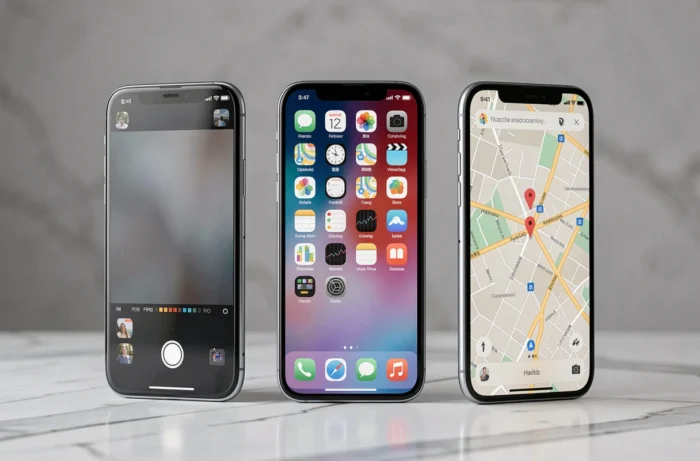
In practice, when comparing flagship models, three aspects make a daily difference: screen quality, photo rendering, and actual battery life.
- Samsung’s high-end displays remain a reference for outdoor brightness and color fidelity, with smooth adaptive refresh rates
- Google’s Pixel phones stand out for their AI-driven photo processing, producing usable shots even in low light, without manual intervention
- The iPhone continues to focus on software consistency and video stabilization, a decisive criterion for those who film regularly
The choice depends on the primary use: spontaneous photo capture, stabilized video, or prolonged visual comfort. None of the three excels in all criteria simultaneously.
Actual battery life: beyond manufacturer claims
The battery life advertised by manufacturers rarely reflects real usage. Under normal conditions (browsing, messaging, occasional streaming), the ultra-high-end models from Samsung and Apple last a full day without difficulty.
The introduction of European standards on battery longevity (80% capacity after 800 cycles) should gradually reduce the gap between first-day battery life and that measured after two years of use. This represents a tangible gain in the medium term.
Repairability score and digital passport: how to read the new smartphone labels
Since June 2025, a specific energy label for smartphones has been included on packaging and online product sheets. This repairability score, rated from A to G, takes into account the availability of parts, ease of disassembly, and the technical documentation provided by the manufacturer.
The European Union is also preparing to integrate a digital product passport, which will centralize information on components, the origin of materials, and repair instructions. This initiative is part of a broader framework of the circular economy applied to electronics.
- The repairability score directly influences shelf visibility and online comparison tools
- Spare parts must be available at a reasonable price, without a prohibitive markup compared to the residual value of the device
This regulatory framework reshapes priorities. A smartphone with a good repairability rating retains better resale value and is cheaper to maintain over time. For a purchase in 2026, checking this score before comparing technical specifications becomes a relevant reflex.