We arrive in Marrakech, take a taxi from the airport, the driver drops off the luggage, and the question arises immediately: how much to leave? Tipping in Morocco does not work like in Europe. It is not calculated based on a percentage displayed at the bottom of the bill, nor is it slipped into a payment terminal. It is almost always paid in cash, in small denominations of dirhams.
Small denominations in dirhams: the constraint that no one prepares for
Most travelers exchange their euros at the airport or withdraw from an ATM. The problem is that the machines often dispense 200 MAD bills, sometimes 100 MAD. For a tip of 10 or 20 dirhams, you find yourself looking for change from the very first day.
The concrete solution: from the first purchase (coffee, bottle of water, small shop), break a large bill. Then keep a reserve of 10 and 20 MAD bills in a dedicated pocket. It is this stock of small denominations that makes interactions smooth throughout the stay.
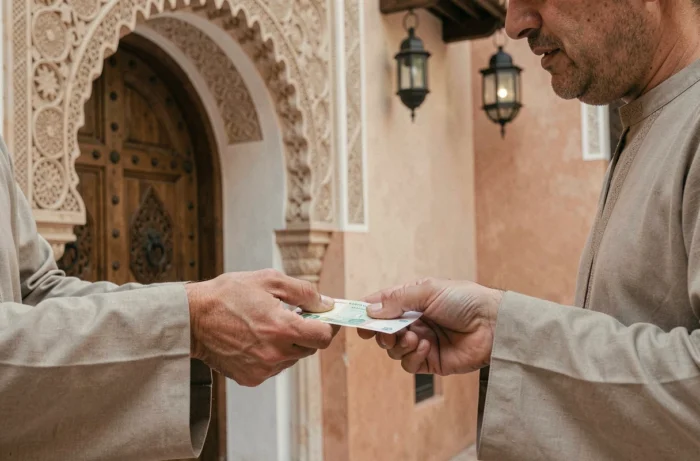
Leaving a tip by credit card remains very rare in Morocco. Payment terminals are becoming common in upscale hotels and restaurants, but tips are almost always given in cash, directly into the hand of the person concerned. A detailed article on tipping in Morocco: customs and practices confirms this very concrete functioning.
Tip amounts in Morocco by situation
You don’t give the same amount to a café server as to a guide who has accompanied us all day. Here are the concrete benchmarks, expressed in dirhams (MAD).
Restaurants and cafés
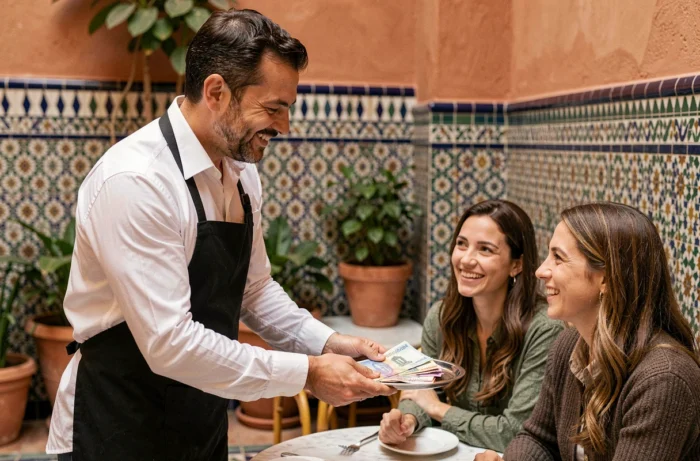
In a café or a small neighborhood restaurant, you leave a few dirhams on the table when leaving. For a more elaborate meal, the range is around 10 to 20 MAD. Some bills now state “service included,” but an additional tip is appreciated if the service was good.
Guides and private drivers
On an organized tour or a day trip, the guide and the driver are two distinct people, and each expects a separate tip. For a full day, budgeting around 50 to 100 MAD for the guide and 30 to 50 MAD for the driver is a common benchmark. On a multi-day tour, tips are generally given at the end of the journey.
Accommodations: riads and hotels
The porter, the housekeeper, the cook in a small riad: every person providing a direct service can receive a tip. For carrying luggage, 10 to 20 MAD per intervention is the norm. For housekeeping, a similar amount is left per day, ideally at the end of the stay.
Bakchich and tips: the distinction to understand
The word “bakchich” often appears in travel guides, but it covers two different realities. The classic tip rewards a service rendered (meal served, room cleaned, guided tour). Bakchich in the broader sense also refers to those small amounts requested spontaneously by someone offering unsolicited help: an improvised parking attendant, a person indicating a path in the medina, a child opening a door.
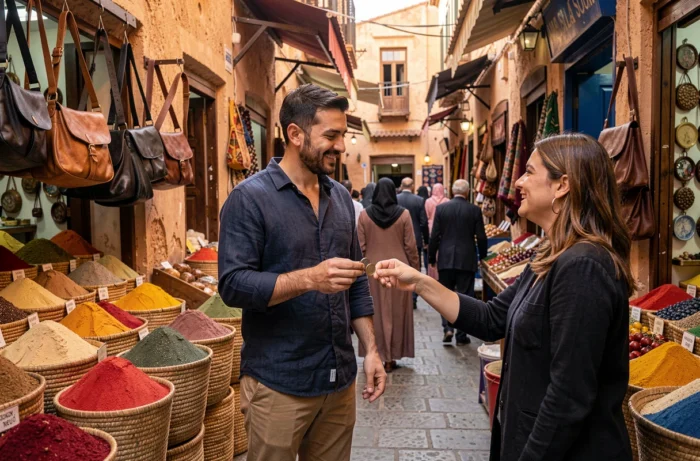
Refusing an unjustified bakchich is neither impolite nor unusual. If you haven’t asked for anything and the service provides nothing, a smile and a “no, thank you” are sufficient. However, if someone has genuinely helped us (carrying a heavy bag through narrow alleys, for example), a few dirhams are a natural gesture.
Tipping in less touristy areas of Morocco
In Marrakech, Fes, or Essaouira, tipping habits are well established and amounts are relatively standardized. In rural areas (Atlas, Dades Valley, Berber villages), the situation changes.
Feedback varies on this point: some travelers find that tipping is less expected there, while others note that even very small amounts generate marked appreciation. What does not change is the importance of the gesture rather than the amount. Giving 5 to 10 MAD to a muleteer after a hike or to a family that prepared tea in an isolated village remains a respectful exchange.
- In artisan cooperatives (carpets, argan oil), tipping is not customary: the purchase directly supports the activity.
- When visiting locals, if we are offered a meal or tea, a small discreet financial gesture is often more appropriate than an embarrassed refusal.
- For guardians of little-frequented historical sites, a few dirhams are enough to thank for a spontaneous explanation.
Tipping budget for a trip to Morocco: how much to plan
Rather than leaving with a vague envelope, one can estimate a realistic tipping budget before departure. For a week-long stay with visits, restaurants, and travel, budgeting the equivalent of 200 to 400 MAD covers most situations without stress.
Converting part of your budget into small denominations from the first day avoids awkward moments where you rummage through your wallet in front of someone who is waiting. Tipping works better when it is prepared in advance, not improvised.
The mention “service included” on bills is spreading in urban establishments, gradually bringing Morocco closer to international standards. But in the vast majority of cases, tipping remains a structural supplement to the income of tourism workers, not an optional bonus. Giving an appropriate tip is recognizing work that is often poorly compensated at its core.