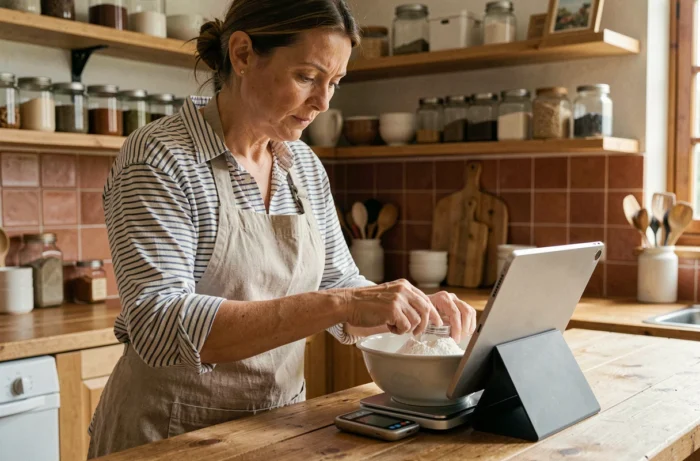
An American recipe states “1 cup of flour,” and the reflex is to look for an equivalent in grams. The problem starts there: depending on the standard used, this cup corresponds to different volumes, and the actual weight depends on the ingredient measured. Without reliable conversion, the gap between the expected result and the obtained result widens from the first weighing.
Cup, mug, cup: why volume is not a reliable unit in baking
The American cup, the Canadian cup, and the British imperial cup do not refer to the same volume. The US cup corresponds to about 236 ml, the Canadian or Australian metric cup to 250 ml, and the British imperial cup to 284 ml. This single variation significantly alters the proportions of a recipe.
The real trap lies downstream: one cup of flour does not weigh the same as one cup of sugar. The density of each ingredient transforms a volumetric measurement into an approximation. One cup of sifted flour, one cup of packed flour, and one cup of spooned flour yield three distinct masses. In baking, where the ratios of flour-liquid-fat determine the texture, this imprecision is enough to tip the result.
We recommend treating any recipe expressed in cups as a recipe to be converted into grams before execution, not as a recipe to be followed as is with a set of measuring cups. This is precisely what the weight converter from Double Portion allows, associating each ingredient with its actual mass rather than a generic volume.

Volume-weight conversion by ingredient: the only method that works
A single conversion table (1 cup = X grams) is a misleading simplification. The conversion must be done ingredient by ingredient, taking into account the specific density. Butter, honey, almond flour, and T55 wheat flour do not occupy the same volume for the same weight.
Let’s take a common example: the difference between granulated sugar and powdered sugar. At the same volume, powdered sugar is significantly lighter because its fine granulation traps more air. Using the same equivalence for both skews the measurement.
Ingredients where the discrepancy is most pronounced
- Flours: depending on whether they are sifted, compacted, or simply poured, the mass difference for the same volume can reach a quarter of the total weight. Coconut flour, which is highly absorbent, exacerbates the problem.
- Fats: melted butter, softened butter, and diced butter do not behave the same volumetrically. An Anglo-Saxon recipe that calls for “1/2 cup butter” does not always specify the state of the butter.
- Viscous liquids: honey, maple syrup, molasses. Their density is higher than that of water, meaning that one cup of honey weighs significantly more than one cup of milk.
Weighing each ingredient in grams remains the most reproducible method. Professional recipes impose this for this reason.
Tablespoons and teaspoons: the false Franco-American friends
In a Francophone context, a tablespoon (c. à s.) commonly refers to 15 ml and a teaspoon (c. à c.) to 5 ml. These values align with the North American standard of tablespoon and teaspoon. The confusion arises elsewhere.
Many French recipes use “tablespoon” as an approximate measure, filled level or heaped depending on the author’s habit. A heaped spoon contains almost double that of a level spoon, which poses a real problem for spices, baking powder, or cocoa powder, where a few grams change the taste or the rise.
When we adapt an American recipe, we observe another discrepancy: the “teaspoon” of baking soda is always level in US cookbooks, while the French “cuillère à café” is often interpreted as slightly heaped. On a leavening agent, this difference translates into an aftertaste or a rubbery texture.
Practical rule for spoon conversions
Systematically convert to grams whenever the ingredient is an active agent (yeast, baking soda, powdered gelatin, agar-agar). For salt, ground spices, and liquid flavorings, a level spoon remains acceptable if calibrated.
Thermostat, degrees Celsius and Fahrenheit: harmonizing cooking temperatures
English-language recipes indicate temperature in degrees Fahrenheit. French recipes oscillate between degrees Celsius and thermostat, without always specifying which one. The thermostat corresponds to a multiple of 30 °C: thermostat 6 equals 180 °C, thermostat 7 equals 210 °C.
The Fahrenheit-Celsius conversion follows a simple formula, but the most common error is not mathematical. It comes from the oven itself: domestic ovens have real temperature discrepancies compared to the displayed value. Converting 350 °F to 177 °C and then setting the oven to 180 °C is correct in theory, but unnecessary if the oven heats to 170 °C in reality.
An independent oven thermometer remains the logical complement to any temperature conversion. The precision of the converter does not compensate for the imprecision of the appliance.
Adapting quantities to the number of diners without altering proportions
Multiplying all ingredients by the same coefficient works for a vinaigrette or a soup. For a leavened dough, a sponge cake, or a custard, linear proportionality reaches its limits.
- Leavening agents do not multiply proportionally beyond a certain threshold: doubling the yeast to double the amount of dough often produces a bitter taste and an uneven crumb.
- Cooking times change with volume: a cake in a larger but shallower pan does not cook at the same speed as a thicker cake in a smaller pan.
- Eggs pose a unit problem: going from 3 to 4.5 eggs makes no practical sense. The solution is to beat the nearest number of eggs, weigh the mixture, and then take the exact required mass.
Smart resizing requires treating each category of ingredient separately, not applying a uniform coefficient to the entire list.
A culinary measurement converter does not replace the understanding of each ingredient’s behavior. It eliminates arithmetic errors and unit ambiguities, freeing attention for the decisions that matter: adjusting a texture, correcting a seasoning, adapting a cooking time. The precision of the conversion is a prerequisite, not a guarantee of success.