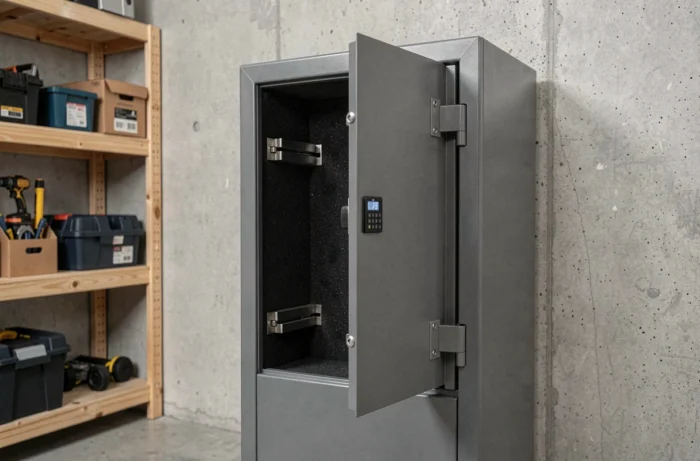
The secure storage of firearms is not just about sliding a rifle into a locked metal cabinet. The French decree requires holders of category C firearms to keep them in a safe or a strongbox, but it also allows for the disassembly of a security component or the installation of a device preventing removal.
This alternative, rarely highlighted, can avoid unnecessary purchases if your firearms collection is small. Before browsing the Brico Dépôt catalog, it is essential to understand what distinguishes a compliant cabinet from a simple metal box sold as such.
Certification and documentary proof: what a “grade I” marking is really worth
A commercial label displaying “grade I” or “EN 1143-1 standard” on the box does not constitute usable proof of compliance in case of inspection. Compliance is proven by a certificate issued by an authorized body, not by a simple manufacturer’s sticker. We recommend always requesting this document before purchase, including at large DIY stores.
This distinction has direct consequences. In the event of theft followed by legal proceedings, the absence of a certificate can weaken the holder’s position. The fact that the cabinet was purchased from a recognized retailer does not replace the documentary traceability of the certification.
Before buying a gun cabinet at Brico Dépôt, check that the product sheet explicitly mentions the certifying body and the test report number. If this information is missing, contact the store’s customer service to obtain the document before finalizing the order.
Sizing a strongbox: usable volume versus advertised number of rifles
The product sheets indicate a capacity in “number of rifles” (3, 5, 8, or more). This marketing figure masks the reality of sizing. The usable volume per long gun is around twenty liters, while a short gun requires significantly less space. A cabinet advertised for five rifles may not necessarily accommodate five scoped rifles, whose dimensions exceed those of a smoothbore shotgun.
We regularly observe this trap among buyers at large DIY stores: the cabinet arrives, the guns do not fit with their accessories, and the investment is lost. Before purchasing, measure the overall length of your bulkiest firearm (including the stock and mounted scope) and compare it to the internal usable height, not the external height of the cabinet.
Ammunition and separate compartment
Regulations require ammunition to be stored separately from firearms or in a distinct closed compartment within the same cabinet. Some models sold at Brico Dépôt include a dedicated internal box. Others do not, necessitating the purchase of a second safe for ammunition. Check for the presence of an internal box before confirming your choice, or risk doubling your expenses.
Floor and wall mounting: the weak point that burglars exploit
A recent theft of firearms from a sports shooter, reported in August 2026 by the specialized press, confirmed that an unsecured or poorly sealed safe can be moved in minutes with a simple crowbar. A safe that is not anchored to the floor or wall fulfills only part of its function.
The mounting relies on two technical criteria:
- The number and diameter of the anchoring points provided by the manufacturer. A serious model offers at least four fixing holes, two in the floor and two in the back wall.
- The nature of the receiving support. A drywall wall on a wooden frame offers no resistance to pulling. It must be anchored in concrete, solid blocks, or stone, using suitable metal expansion anchors for the load.
- The weight of the empty cabinet. Below thirty kilograms, the entire unit remains transportable by two people, with or without mounting. Opt for the heaviest models your budget allows.
At Brico Dépôt, the mounting kit is not always included. Plan to purchase anchors suitable for the support, and refuse the plastic anchors provided in some packages.
Key lock or electronic lock: technical arbitration for gun cabinets
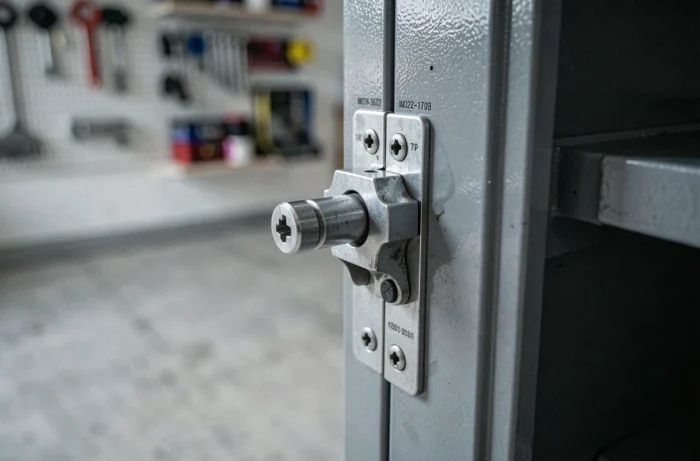
Entry-level gun cabinets at large DIY stores predominantly use key locks with grooves. This mechanism, reliable but basic, has a known flaw: losing the key necessitates a complete replacement of the cylinder, a task sometimes impossible on cheaper models for which spare parts are not available.
The electronic lock with code offers an obvious practical advantage (no key to keep), but introduces a dependency on batteries. A well-designed model signals battery depletion several weeks before failure. On lower-end models, the absence of this signal leads to blockages that require opening by a locksmith, with the risk of damaging the door.
Combination of both systems
Mid-range cabinets sometimes offer double locking (key + code). This combination significantly slows down an attempted break-in, as it requires neutralizing two independent mechanisms. If your budget allows, this is the option we recommend for domestic storage of category C firearms.
Availability and logistics at Brico Dépôt: what to anticipate
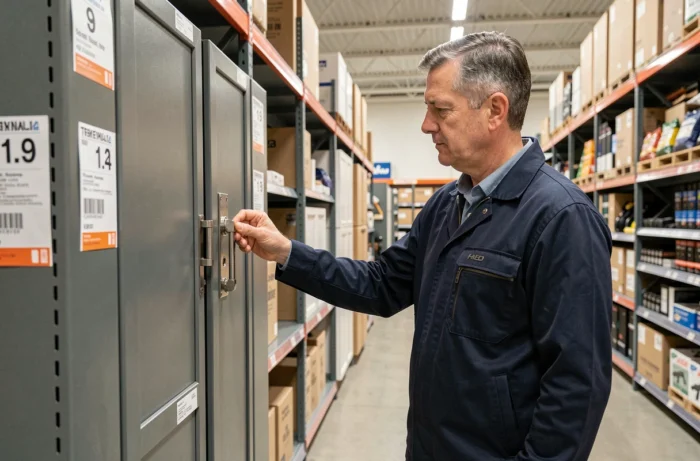
Gun cabinets are not part of the permanent stock at all stores. Brico Dépôt operates on a replenishment basis, meaning a model spotted online may not be available in-store the following week. Reserve online and pick up in-store to ensure availability.
Transportation also deserves consideration. A standard-sized strongbox weighs several dozen kilograms. Home delivery, when offered, often stops at the bottom of the building or at the threshold of the house. Plan for handling to the destination room and, if possible, secure the cabinet on the same day of receipt to avoid moving it twice.
The market for gun cabinets at large DIY stores meets the common needs of hunters and shooters with a few firearms. For a larger collection or category B firearms, turn to a gunsmith or a safe specialist, whose products meet more demanding certification levels.