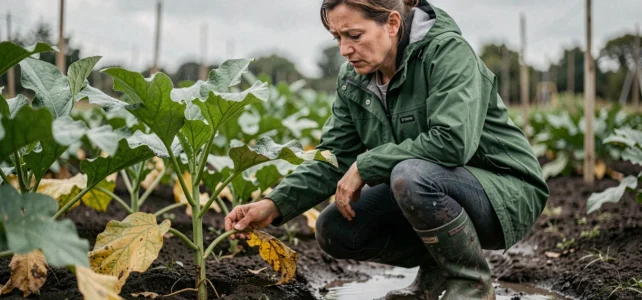
The eggplant does not tolerate stagnant water at the collar well. A prolonged rainy episode on heavy soil is enough to trigger root asphyxiation, followed by rapid fungal colonization. Protecting the plants from excess moisture is not just about putting up a shelter: it is a combination of drainage, mulch management, and collar monitoring that makes the difference between a decent harvest and plants that wither in a few days.
Root Asphyxiation in Eggplants: The Mechanism to Understand Before Acting
Water-saturated soil pushes oxygen out of the macropores. The fine and sensitive roots of the eggplant stop absorbing nutrients when the oxygen level in the root zone drops. Within a few hours, the absorbing hairs die.
The problem worsens when the gardener walks on waterlogged soil or works it too early. The resulting compaction destroys the soil structure and worsens stagnation during the next rainy episode. The University of Georgia explicitly recommends avoiding any soil work as long as it remains waterlogged.
Once the soil is drying out, we recommend very superficial scratching, on the first two or three centimeters, to re-oxygenate the top layer without turning the soil deeply. This action breaks the crust that forms after heavy rain and restores gas exchanges. To better understand the specific sensitivity of this vegetable to precipitation, you can read the article on Graine de Jardinier that details the risks involved.
Mulching After Rain in the Vegetable Garden: Lift Rather Than Leave in Place
The usual reflex is to maintain the mulch under all circumstances. After an intense rainy episode, this reflex becomes counterproductive for eggplants.
A mulch pressed against a wet collar accelerates rot. Moisture remains trapped between the organic matter and the stem, creating a microclimate favorable to pathogenic fungi. Modes et Travaux emphasizes a precise action: pull back the mulch around the collar and lift it in small patches to allow the soil to dry out.
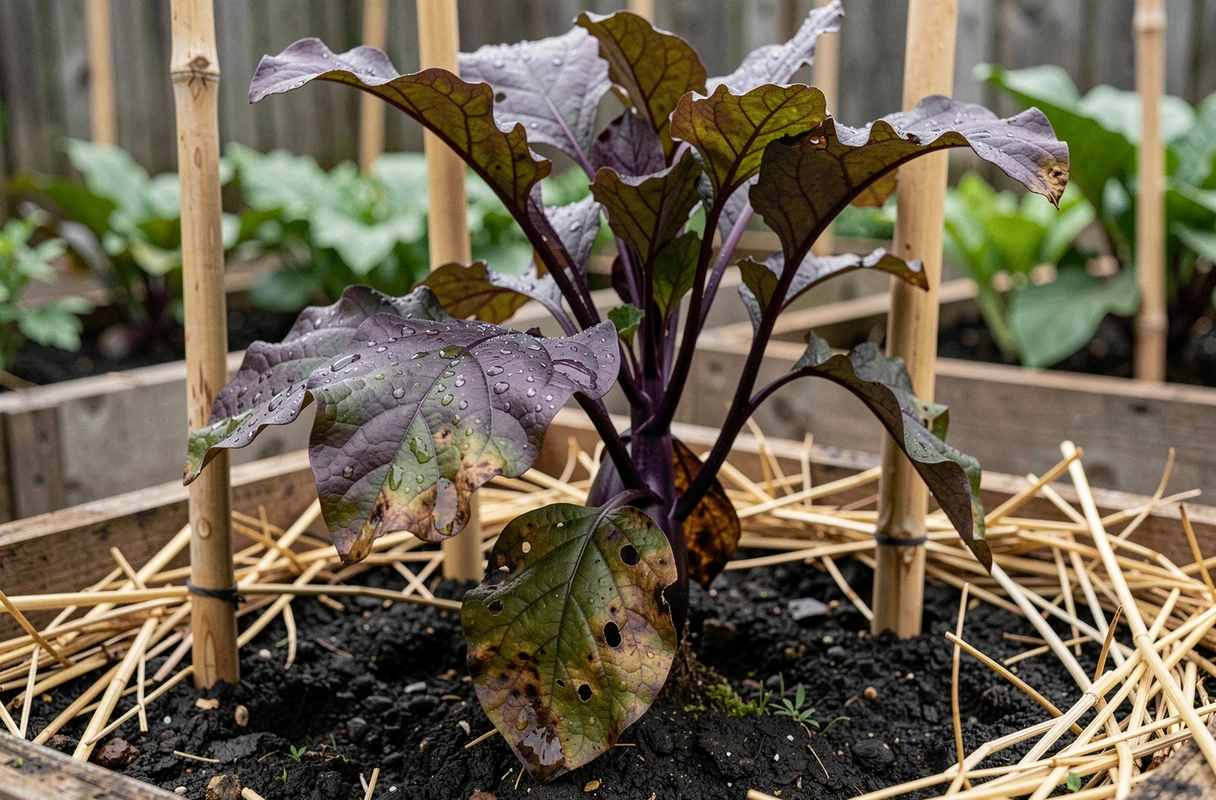
In practice, we observe that maintaining a clear space of five to ten centimeters around each plant significantly reduces cases of collar rot. The mulch can be replaced once the soil is no longer shiny on the surface.
The type of mulch also matters. A dense and compact mulch (fresh cuttings, whole leaves) retains more water than an airy mulch (wheat straw, coarse wood chips). In plots with clay soil, we recommend switching to structured mulch as soon as the eggplants are planted, not after the first problem.
Localized Drainage and Raised Beds: Preparing the Soil Before the Rainy Season
Installing a shelter or a cover does not solve anything if the soil retains water. Drainage should be prepared in advance, ideally at the time of setting up the growing beds.
- Plant the eggplants on raised beds of fifteen to twenty centimeters, especially in clay or loamy soil. The elevation allows for quick drying and keeps the collar away from the saturation zone.
- Incorporate mature compost and coarse sand into the top layer to improve porosity. A soil that cracks as it dries is a soil that becomes waterlogged when wet.
- Create a slight slope between the rows so that runoff water drains to a buffer area (grassy path, ditch). Water should never stagnate at the base of the plants.
- Prefer drip irrigation over sprinkling, even in addition to rain. The University of Georgia classifies sprinkling as an aggravating factor for foliar diseases in solanaceous plants.
These arrangements do not require heavy work. They can be implemented at the time of transplanting and protect the crops throughout the season.
Fungal Diseases of Eggplants Related to Moisture: Identify and React Quickly
Excess water on the foliage and soil promotes three main pathologies in eggplants. Recognizing them early changes the prognosis for the plant.
Powdery mildew appears as a white powdery coating on the leaves. It typically occurs when cool, humid nights follow warm days. A wet foliage at the end of the day is the classic trigger.
Botrytis (gray mold) attacks the fruits and stems when ambient humidity remains high for several consecutive days. The tissues become soft, brown, and then covered with a characteristic grayish fuzz.
Collar rot, linked to various soil fungi, affects the base of the stem. It progresses quickly on a plant whose collar remains in constant contact with waterlogged soil or wet mulch.
In all three cases, prevention relies on the same principles:
- Keep the foliage dry by watering exclusively at the base, never by sprinkling
- Space the plants sufficiently to allow air circulation between the rows
- Immediately remove affected leaves to limit the spread of spores
- Avoid any excessive nitrogen input, which produces dense and tender foliage, more vulnerable to infections
Shelter and Protective Cover for Eggplants: What Really Works
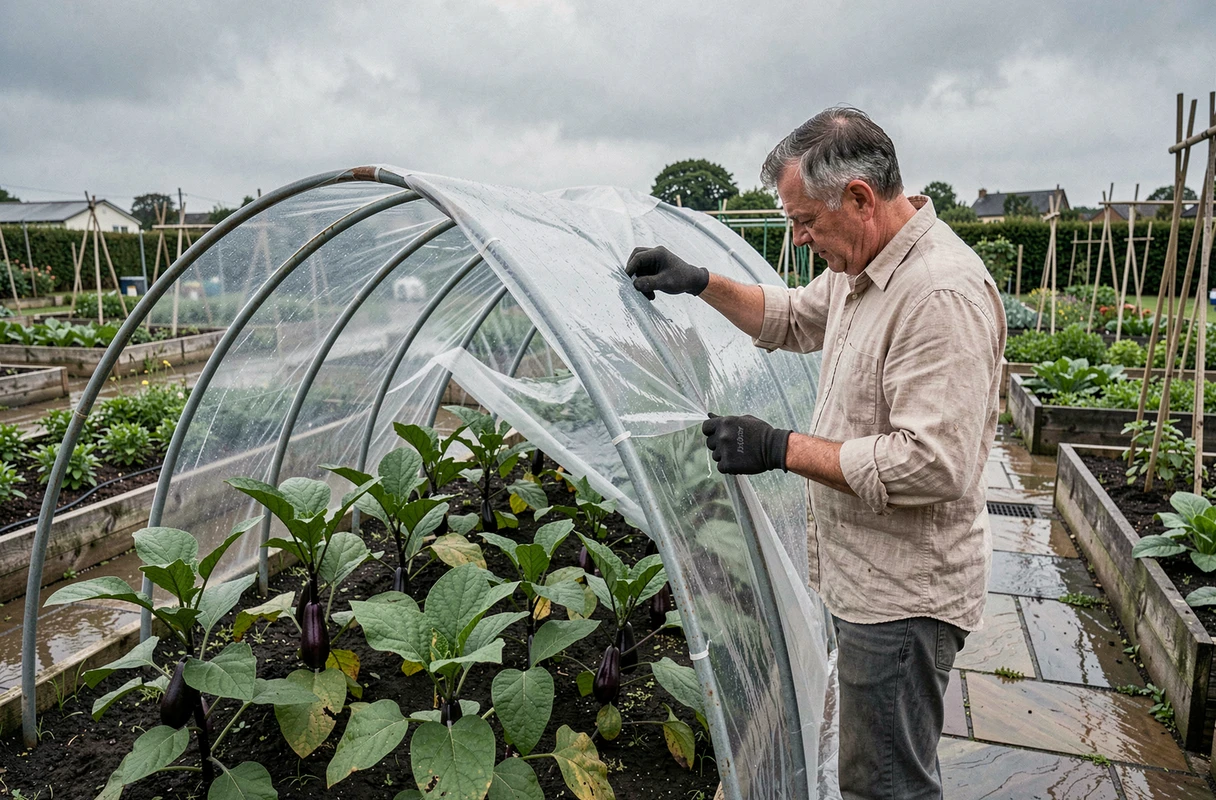
A Nantes tunnel or a simple roof open on the sides protects the foliage from direct rain while allowing air circulation. This is the most effective configuration for eggplants, much more than a closed greenhouse where the relative humidity can exceed the critical threshold without ventilation.
The forcing cover, often used at the beginning of the season to gain a few degrees at night, should be removed as soon as nighttime temperatures stabilize. Left in place during humid weather, it traps condensation against the foliage and reproduces exactly the conditions we seek to avoid.
We recommend a shelter with at least two open sides, oriented so that the prevailing wind passes through the structure. The goal is not to eliminate rain but to prevent water from stagnating on the leaves and at the collar. A wet plant that dries in an hour does not develop disease. A plant that remains wet all night, does.
Protecting eggplants from excess moisture relies on a series of coherent actions: drained soil, actively managed mulch, clear collar, ventilated foliage. None of these actions is sufficient alone, but their combination makes the plants remarkably resilient, even during prolonged rainy seasons.