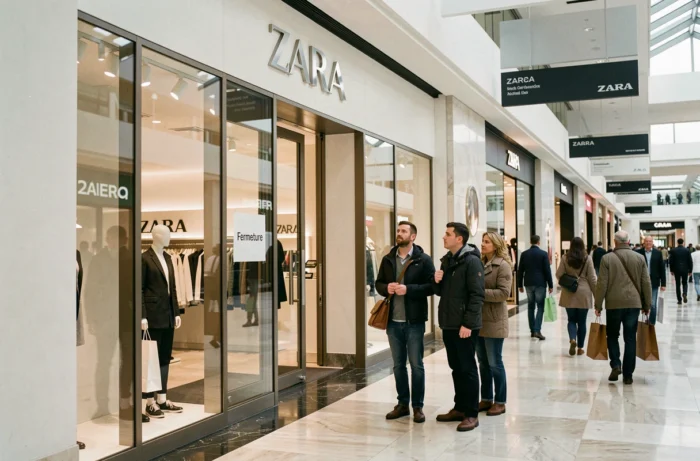
Inditex is not leaving medium-sized cities by accident. The reduction of the Zara, Bershka, and Stradivarius store network follows an industrial logic tested over several years: closing secondary locations, concentrating flows on large flagship stores, and integrating each physical point of sale into the digital channel. Between 2018 and 2025, the group has reduced its store count by about 27%, while increasing its net profit.
Surface threshold and flagship model: the filter Inditex applies to its network
Inditex management has set a floor area of around 4,000 m² for its new Zara stores. This threshold is not arbitrary: it corresponds to the format necessary to integrate quick pickup areas for online orders, self-checkouts, and assisted return spaces.
The flagship reopened in Almere, Netherlands, illustrates this logic. With 4,900 m² of space, nearly three times the size of the old store, it concentrates all omnichannel services in one location. The model is replicated in South Korea, where Zara has relocated its Gangnam flagship to create a global retail laboratory.
In Spain, Inditex closed 136 stores in one year. We observe the same dynamic in France: the stores of Ruban Bleu in Saint-Nazaire (Zara, Bershka, Pull and Bear, Stradivarius) were closed because they did not meet the surface area and profitability criteria of the new model. As noted by Tiffany and Co news, this wave of closures affects entire cities, not isolated brands.

Closure of Zara in France: medium-sized cities facing Inditex’s disengagement
The case of Saint-Nazaire is symptomatic but not unique. The simultaneous closure of four Inditex brands in the same shopping center reveals a coordinated withdrawal, not a series of independent decisions. The group is terminating leases, freeing up spaces, and redirecting investments towards metropolitan areas.
David Samzun, mayor of Saint-Nazaire, publicly denounced the group’s disregard for its employees and customers, recalling the public investments made to redevelop the city center. Inditex’s response has been clear: the group is focusing on larger stores based on a different concept.
What medium-sized shopping centers are concretely losing
A Zara store generates a flow of visitors that benefits the entire shopping gallery. When four brands from the same group close simultaneously, the effect on foot traffic is multiplicative. Neighboring businesses lose part of their passing clientele, and the center’s owner must re-rent spaces in an already pressured rental market.
Employees, on the other hand, face often unrealistic internal reclassifications. Being offered a position in a flagship located hundreds of kilometers away is not a solution for a locally rooted employee.
Inditex’s financial results: fewer stores, more profits
The strategy works from a shareholder perspective. Inditex has increased its profits while reducing its physical store count, a pattern that few textile retailers manage to replicate. The group has outperformed its direct competitors H&M and Gap in terms of financial performance, even as the clothing sector faces a structural crisis.
Three levers explain this increased profitability despite the closures:
- Focusing on prime locations reduces unproductive rents and increases revenue per square meter.
- Omnichannel integration (click and collect, in-store returns) transforms each flagship into a local logistics hub, which decreases last-mile delivery costs.
- The reduction in the number of points of sale simplifies inventory management and limits unsold items, a major cost factor in fast fashion.
This model has a blind spot: it assumes that customers in medium-sized cities will naturally shift to e-commerce or travel to metropolitan areas. There is no guarantee that this assumption will hold true in the long term, especially in a context where the cost of online returns weighs on the margins of the digital channel.

Impact on fashion and city center commerce in France
Inditex’s withdrawal from medium-sized cities accelerates a phenomenon already documented: the commercial decline of intermediate city centers. Zara played a locomotive role comparable to that of a hypermarket on the outskirts. Its departure leaves a void that independent retailers or niche brands struggle to fill, lacking the same drawing power.
A signal for the entire ready-to-wear sector
Other textile groups are observing Inditex’s trajectory. If the “fewer stores, larger, more digitalized” model continues to yield superior financial results, we can anticipate similar decisions at brands like H&M or Mango. The territorial network of French ready-to-wear could contract significantly in the coming years.
For consumers in the affected areas, the shift to online shopping is not neutral. Fitting rooms disappear, returns increase, and the shopping experience becomes standardized. Municipalities, in turn, lose both property tax revenue, local jobs, and an attractiveness factor for their city centers.
The Inditex case raises a question that the sector avoids: can profitability per square meter remain the sole criterion for maintaining a store, when the social and urban externalities of withdrawal are not reflected in any financial statement? Local authorities currently have no legal leverage to prevent these departures. And consumers, for their part, vote with their credit cards, often on the Zara app itself.